Introduction
If your trousers are too long, you can shorten them yourself with a few basic sewing tools. Learning how to hem trousers is a useful skill, especially when you have a favourite pair that needs a little adjustment.
The first thing to get right is the length. Once you have measured with your shoes on, you can decide whether to sew the hem by hand or use a machine.
Key Takeaways
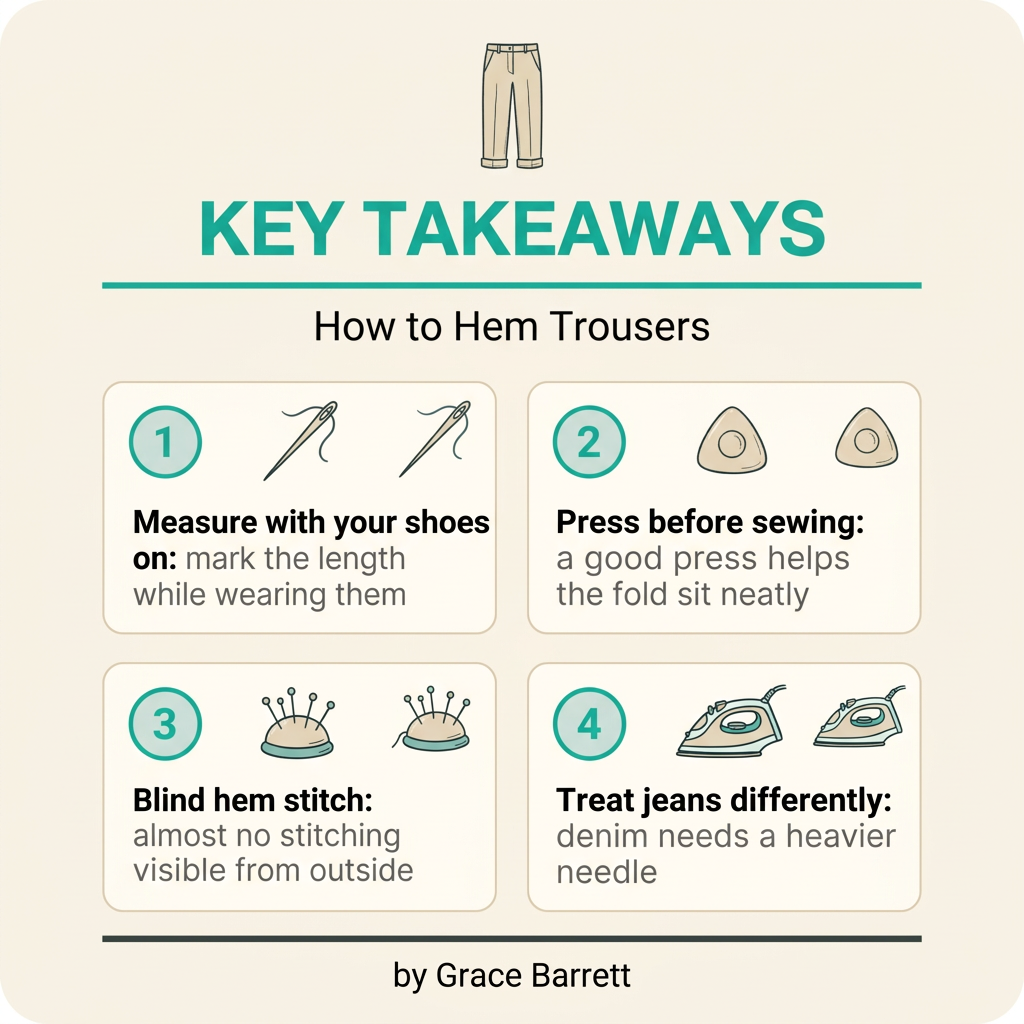
- Measure with your shoes on: Wear the shoes you plan to use with your trousers before marking the length.
- Press before sewing: A good press helps the folded fabric sit neatly.
- Choose a blind hem stitch: Hand sewing can leave very little stitching visible on the outside.
- Treat jeans differently: Denim needs a suitable heavier needle, stronger thread and a topstitched finish.
How to Hem Trousers in Six Steps
If you want to know how to hem trousers, start by putting them on with the shoes you normally wear. Decide where you want the finished hem to sit and mark the position with pins or fabric chalk. Take your time here, as getting the length right makes the rest of the job much easier.
Follow these six steps:
- Mark the length: Fold each trouser leg to the position you want and mark the fabric.
- Unpick the old hem: Use a seam ripper to remove the existing stitching carefully.
- Cut the excess fabric: Leave enough material for the new turn-up. Keep away from the finished length when cutting.
- Fold and press: Turn the fabric up evenly and press it with an iron.
- Pin in place: Check that the folded hem sits evenly around both legs.
- Sew the hem: Use a blind hem stitch by hand for a discreet finish, or a machine stitch if you prefer visible stitching.
The same steps apply when you want to take up trousers that are too long. Straight-legged trousers with a simple hem are a good place to start. Lined trousers and more complicated shapes need a little more experience.
You can read about the alterations you can safely teach yourself if you are starting to learn basic clothing repairs.
As explained in Wikipedia’s guide to hems, a common method is to fold the cut edge twice and sew it down. This encloses the raw edge and helps prevent the fabric from fraying.
How to Shorten Trousers: Measuring and Marking
Before you reach for your scissors, make sure you are happy with the finished length. Put your trousers on with the shoes you intend to wear. A pair that looks the right length without shoes may sit quite differently once you are dressed.
Stand naturally in front of a full-length mirror. If possible, ask someone to help you mark the fabric while you stand straight. Decide where you want the hem to fall, then place a few pins around the trouser leg.
Check the front, back and sides. The hem should sit evenly rather than rising at one side.
Mark each leg separately. Even if the trousers look identical, one leg may hang slightly differently when worn. It is worth checking both rather than assuming the same measurement will work.
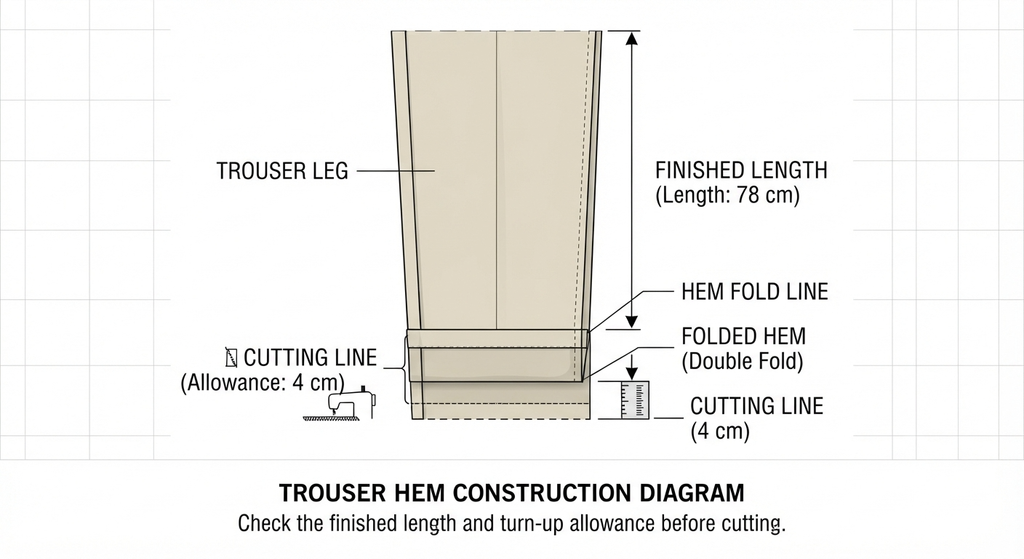
Once you have marked the finished length, measure the fabric needed for the turn-up. Allow enough material for the folds and stitching. If you are making a double-fold hem, remember that you will need fabric for both folds.
Turn the trousers inside out and check your measurements again before cutting. Once the excess fabric is gone, there is very little room to correct a mistake.
How to Hem Trousers by Hand
You do not need a sewing machine to produce a neat trouser hem. Hand sewing gives you more control over small stitches, particularly when you want the stitching to remain hidden from the outside.
Gather a few basic supplies before starting:
- A hand-sewing needle suitable for your fabric.
- Thread that matches the colour of your trousers.
- Fabric scissors.
- Pins.
- An iron and ironing board.
- A seam ripper.
Choose a thread that blends into the fabric. A close colour match helps keep the finished stitching discreet.
Fold and press the hem, then hold it in place with pins. Thread your needle and tie a small knot at the end. Work around the inside of the trouser leg, keeping your stitches small and evenly spaced.
Try not to pull the thread too tightly, as this can make the fabric gather. If you have not done much hand sewing before, practise on a scrap of material first.
You can practise the slip stitch this hem builds on before working on your trousers.
A survey reported by the British Heart Foundation in June 2017 found that 37% of people polled could not alter the length of their trousers. You can read the findings in the British Heart Foundation’s report on sewing skills.
Blind Hem Stitch: How the Stitch Catches One or Two Threads of the Outer Fabric
A blind hem stitch is useful when you want to avoid a visible row of stitching on the outside of your trousers.
Fold the fabric into position so that you can work along the inside of the hem. Take a small stitch through the folded fabric, then catch just one or two threads from the outer material. Move along the hem and repeat.
The small stitch on the outside should be difficult to see. If you catch too much of the outer fabric, the thread will show more clearly.
Use a fine needle that suits the material and choose a thread close to its colour. Keep the stitches evenly spaced, and check the outside of the trousers as you work.
How to Hem Trousers With a Sewing Machine
If you have a sewing machine, you can use it to finish a trouser hem. Start by folding and pressing the fabric, then secure it with pins so it does not move while you sew.
There are two methods worth knowing.
Straight stitch: This is a simple option for a standard hem. Sew around the folded edge, keeping the distance from the edge consistent. The stitching will show on the outside, so use a thread that matches your trousers.
Blind hem foot: Some machines have a special foot for blind hemming. It allows the needle to catch a small amount of the outer fabric while most of the stitching stays inside the fold.
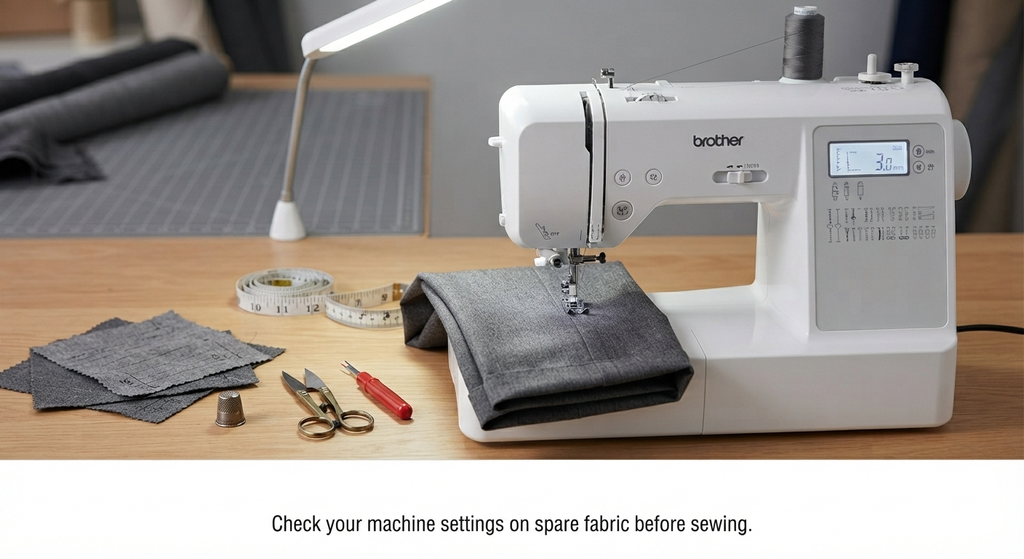
Before sewing your trousers, test the settings on a spare piece of similar fabric. Check that the stitches look even and that the fabric feeds through the machine properly.
If you are new to machine sewing, getting comfortable at the machine first can make this job easier.
You may also find it simpler to finish a difficult section by hand, especially where the trouser leg becomes awkward to position under the machine foot.
How to Hem Jeans
Jeans need a little more attention because denim is thicker than most trouser fabrics. Several layers can be difficult to sew through, particularly where the side seams are bulky.
Start by putting your jeans on with your usual shoes and marking the finished length. Fold the fabric and check how it looks before cutting anything.
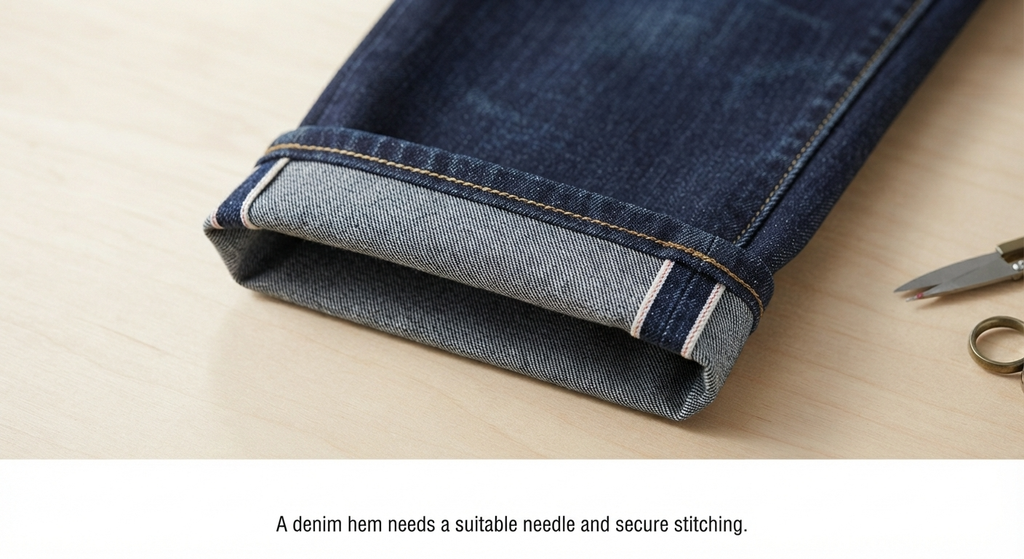
Choose a suitable denim needle and thread that works with the fabric. Fold the raw edge under, then fold it again to enclose the cut edge. Press the fold and pin it in place.
Use a straight stitch to sew around the hem, keeping close to the folded edge. This gives you the familiar topstitched finish. Take care when sewing over thicker areas, as the extra layers can make it harder to keep the stitching straight.
There is also a way to shorten jeans while keeping their original factory hem. Rather than removing the original stitched edge, you adjust the excess fabric above it and secure the shortened length inside the leg. Check the finished position carefully before sewing.
If you need a needle that will go through denim, choose one designed for thicker fabric.
| Trouser type | Hem method | Stitch | Needle |
|---|---|---|---|
| Lightweight trousers | Double-fold hem | Slip or blind stitch | Fine hand needle |
| Everyday trousers | Double-fold hem | Straight stitch | General-purpose machine needle |
| Jeans | Double-fold hem | Topstitch | Denim needle |
| Jeans with original hem | Preserve original hem | Original-style topstitch | Denim needle |
When to Take Them to a Tailor
Some trousers are easier to alter than others. A plain hem on straight-legged trousers is a reasonable job to try at home, but more complicated designs may need professional attention.
Lined trousers require extra work because you have to deal with the lining as well as the outer fabric. Cuffed hems also need care if you want to keep their original shape.
Tapered legs can be awkward to hem because the opening becomes narrower towards the ankle. Vents and other construction details can make the job more difficult too.
The Victoria and Albert Museum records changes in trouser construction during the nineteenth century, including the introduction of the fly-front closure as the usual style by the 1830s. You can see this in the V&A collection entry on trousers.
Repairing clothes also gives you another way to keep them in use. WRAP reported in April 2024 that 49% of used textiles in the UK were going into general waste. Its research also reported that the UK bought 1.42 million tonnes of textiles in 2022. Read WRAP’s textile market findings.
The European Environment Agency reported that 3,000 of 3,157 textile items brought to participating Repair Cafes in 2025 were successfully repaired. Trousers and pants had a reported repair success rate of 97%.
Frequently Asked Questions (FAQ)
How to Take Up Trousers Without a Sewing Machine?
You can take up trousers by hand with a needle, matching thread and a blind hem stitch. Measure the length with your shoes on, fold and press the fabric, then sew small stitches along the inside of the hem. This gives you a discreet finish without needing a machine.
How Much Fabric Should You Leave for a Trouser Hem?
The amount depends on the fabric and the style of the trousers. A double-fold hem needs enough material for both folds, so check the existing construction before cutting. Mark your finished length first and allow extra fabric for the turn-up and stitching.
Does Hemming Tape Last?
Hemming tape is another option for shortening trousers, although its durability depends on the product, fabric and care instructions. Check the manufacturer’s guidance before using it. If you are unsure, test it on a hidden section of fabric first.
How to Hem Trousers With a Sewing Machine If You Have Never Used One?
Start with a spare piece of similar fabric and practise sewing a straight line. Once you are comfortable with the machine, fold and press your trouser hem, pin it securely and check your settings. Sew slowly, checking the fabric as you go.
Conclusion
Hemming trousers is a useful alteration to learn, especially when you have clothes that need a small adjustment. Start with a straightforward pair, take your time with the measurements and practise your stitches before working on more expensive fabric.
If you would like some guidance while learning, you can explore a beginners course that covers hems properly.
For more complicated alterations, including tailored garments, you can also find help with lined or tailored trousers.
Sources
- Hem. Wikipedia. Undated. https://en.wikipedia.org/wiki/Hem
- Price of our addiction to cheap fast fashion: pressure builds on UK second-hand market. WRAP. 30 April 2024. https://www.wrap.ngo/media-centre/press-releases/price-our-addiction-cheap-fast-fashion-pressure-builds-uk-second-hand
- Repairability of textile products. European Environment Agency. 6 August 2026. https://www.eea.europa.eu/en/circularity/sectoral-modules/textiles/repairability-of-textile-products
- Trousers, Unknown. Victoria and Albert Museum. Undated. https://collections.vam.ac.uk/item/O75654/trousers-unknown/
- BHF exposes UK sewing skills shortage to launch The Big Stitch campaign. British Heart Foundation. 13 June 2017. https://www.bhf.org.uk/what-we-do/news-from-the-bhf/news-archive/2017/june/bhf-exposes-uk-sewing-skills-shortage-to-launch-the-big-stitch-camapaign