
Key Takeaways
- Learning how to sew starts with the machine, not the sewing: threading, bobbins and tension take up almost all of the first four weeks.
- Month two is about control: the same seam done accurately, plus pressing and hems, and visible progress slows.
- Month three is a paper pattern: notches, grainline and cutting, ending in something you can wear.
- Weeks six to eight are where people stop: habit research puts a new routine at 66 days before it feels automatic.
- A class is not the only route: groups, videos and a relative who sews all work. Teaching earns its keep in month one.
What Learning How to Sew Looks Like in the First Three Months
Learning how to sew is usually described as a pile of skills. Threading, seams, hems, patterns, fabric types, all listed as though you pick them up in any order.
They have an order, and it is fairly consistent from one beginner to the next. This post is the calendar rather than the argument, so if you are still deciding whether you could get there without a teacher at all, that question has its own answer elsewhere on this blog.
The first month goes almost entirely on the machine. The second is control, doing the same thing accurately rather than doing new things. The third is when a paper pattern stops being intimidating.
Three months of weekly practice will not make you good. It will make you competent enough to start a project without dread.
The failure modes matter more than the skills. Nobody quits over a crooked hem, they quit over the thing they could not diagnose.
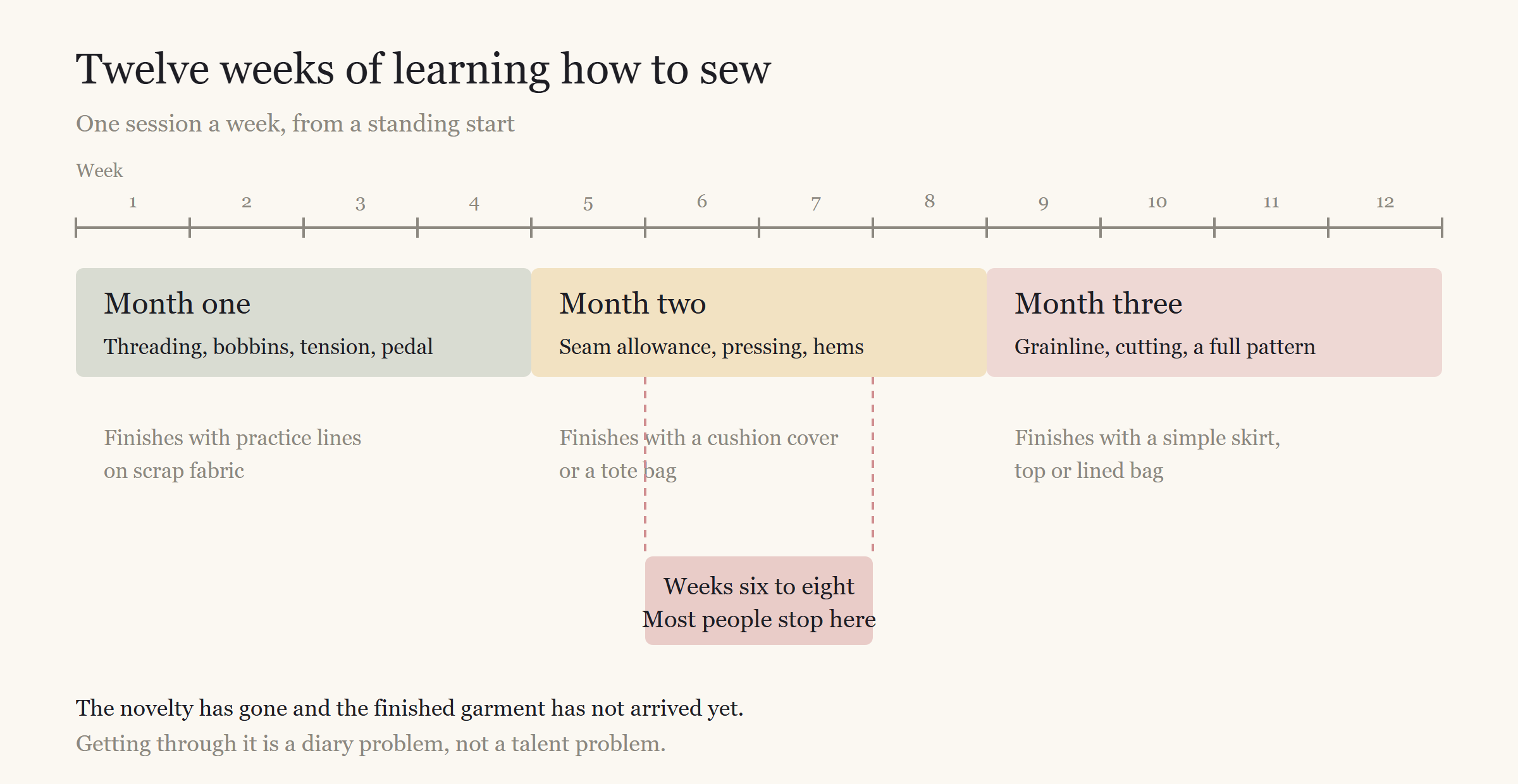
Twelve weeks, drawn by somebody who has watched a lot of week sevens.
Month One: The Machine Is the Whole Job
Almost nobody expects learning how to sew to begin with an appliance.
Weeks one to four go on threading the top thread, winding a bobbin, changing a needle and setting stitch length. Then sewing lines on paper with no thread in the needle, to learn what the foot pedal does to your speed.
The failure mode happens to everybody. A nest of loose thread appears under the fabric, the machine jams, and the beginner concludes the machine is broken.
It almost never is. Usually the top thread is seated wrong, or the presser foot was left up while threading, and both take seconds to fix.
If you want the mechanics of threading, bobbins and tension set out properly, that is a separate guide.
You do not need much to learn basic sewing skills. A machine, thread, pins, a seam ripper and something cheap to practise on, and the short list of kit that earns its place is shorter than most shopping lists suggest.
Month Two: Straight Lines, Then Shapes
Weeks five to eight look like repetition, because they are.
The skill being built is consistency: a seam sewn the same distance from the edge for its length. Then a flat hem, a square corner, a gentle curve.
Pressing turns out to be a separate skill and roughly half the result. Most beginner work looks homemade because it was never pressed, not because it was badly sewn.
It is also the month for a first flat object: a cushion cover, a tote bag, a drawstring pouch.
The failure mode here is quieter than a jammed machine, and more dangerous. Progress stops being visible.
In month one everything is new, so every session feels like a leap. In month two you are doing the same seam better by a margin only a teacher can see, and learning how to sew starts to feel like standing still.
Practising the individual stitches on their own, separately from any project, is the usual way through. Ten minutes of deliberate repetition beats an hour of a project you are quietly avoiding.
Month Three: Reading a Pattern and Finishing Something
Weeks nine to twelve are where a paper pattern stops being foreign.
Notches tell you which edge meets which. The grainline tells you which way to lay the piece on the fabric. The seam allowance is the margin the garment is drafted around.
Cutting accurately matters more than sewing accurately here. A piece cut a centimetre out cannot be rescued.
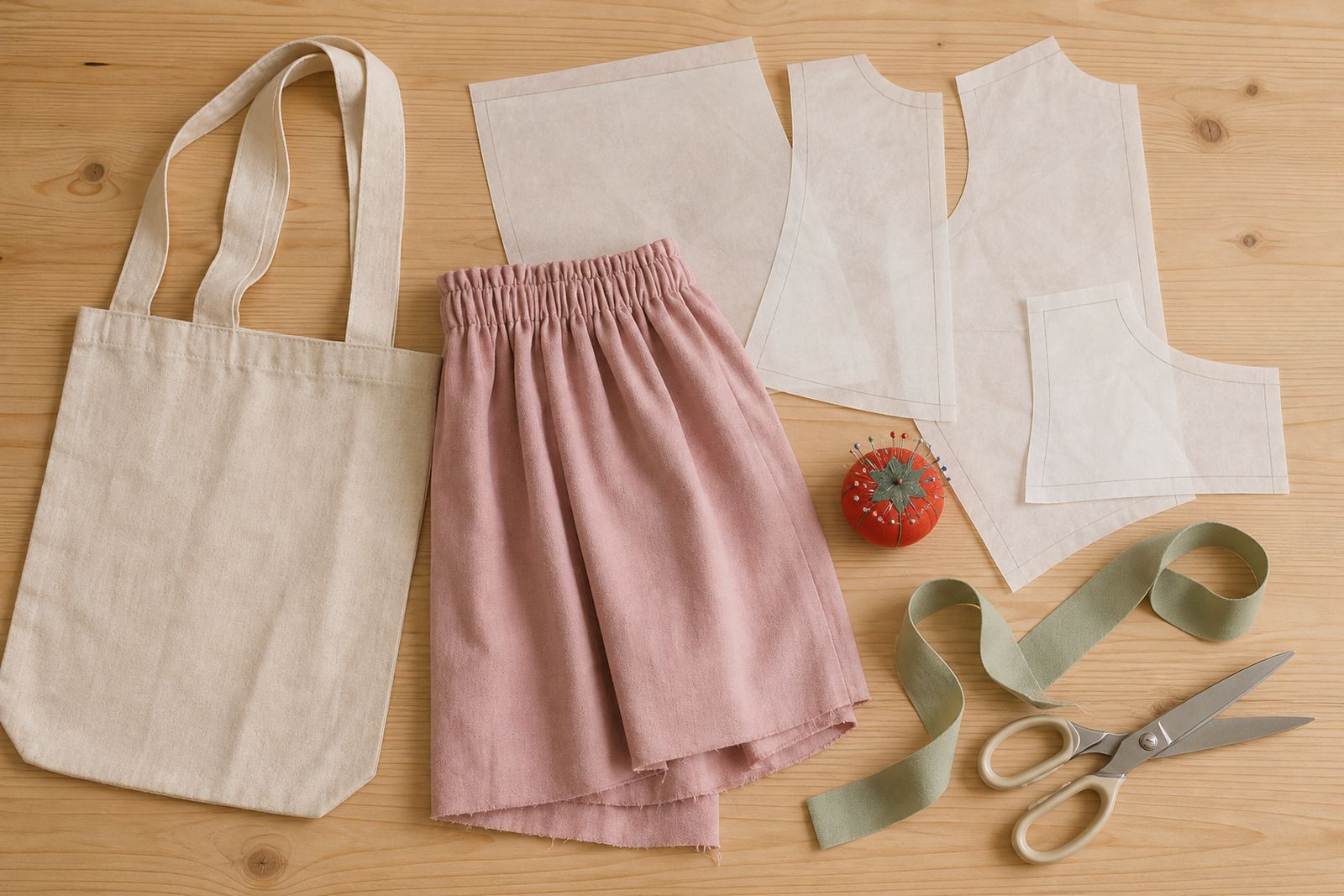
By the end of month three a simple elastic waist skirt, a loose top or a lined bag is realistic.
The failure mode is fit. A pattern is drafted to standard measurements that belong to nobody in particular, so your first garment will be too big somewhere and too tight somewhere else.
That is the pattern being average, not you being unusual. Adjusting for it belongs to month four.
| Month | What you are actually learning | What usually goes wrong | What you can finish |
|---|---|---|---|
| One | Threading, bobbins, tension, needle changes, pedal control | A nest of thread underneath, blamed on the machine | Practice lines on scrap fabric |
| Two | Consistent seam allowance, pressing, hems, corners | Progress stops being visible and motivation goes with it | A cushion cover or a tote bag |
| Three | Reading a pattern, grainline, cutting accurately | Fit, and the discovery that patterns are drafted for nobody | A simple skirt, top or lined bag |
Three months, four columns, and one column nobody warns you about.
Where Most Beginners Stall
Weeks six to eight. That is where learning how to sew usually stops, and it is worth saying before somebody gets there and decides it means something about them.
The novelty of month one has worn off and the results of month three have not arrived.
The research lines up almost exactly. The British Psychological Society reports that in a study of 96 people adopting a new daily behaviour, the average time for it to become automatic was 66 days, with a range from 18 days to a predicted 254.
Even after 84 days, about half the participants had not reached habit level. More complex behaviours took around one and a half times as long, and sewing is not a simple one.
So the machine goes in the cupboard around week seven, roughly three weeks early.
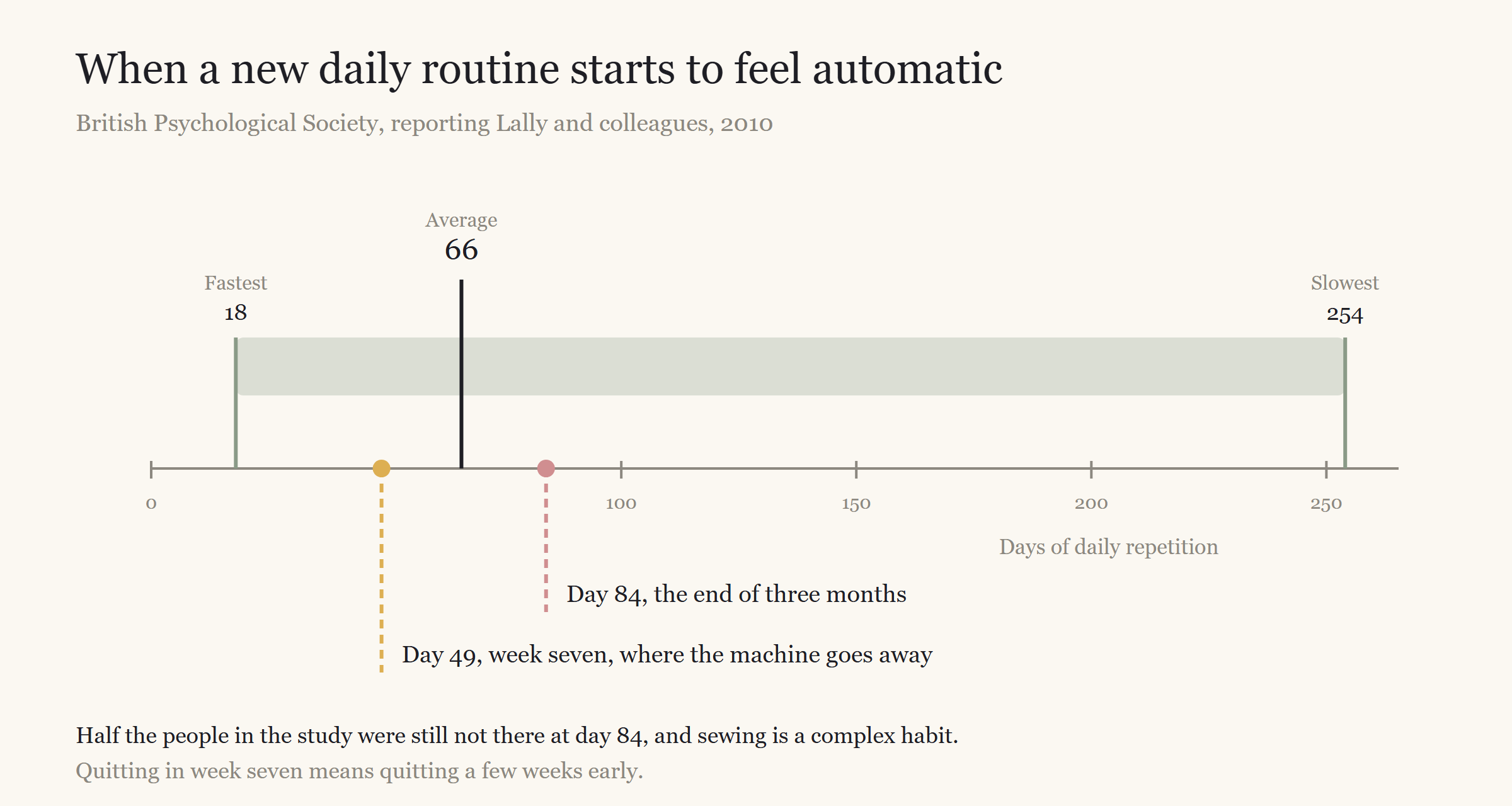
The finish line, and where most people stop running.
A single missed day made almost no difference. It is the accumulation of skipped sessions that lowers the ceiling.
For most of history nobody had this problem, because nobody chose it. The Victoria and Albert Museum records needlework as a marker of virtue rather than a pastime, and notes that eighteenth century warships set aside a make and mend day for repairing clothes.
Sewing was assigned. Nothing assigns it now, so nothing carries you through week seven except a booked session or somebody expecting you at one.
If it is the difficulty putting you off rather than the routine, how difficult the craft really is is answered separately.
Whether You Need Learn to Sew Classes at All
Honestly, not necessarily.
Plenty of people manage learning how to sew from video, from a relative, or from turning up to a group with a bag of mending. If you can diagnose your own faults, self teaching works.
The case for a class is narrow: month one, and diagnosis. A tutor looking over your shoulder names a tension fault in seconds that would cost a solo learner an evening.
After that first month the advantage narrows, and what keeps people coming back tends to be the company rather than the instruction.
North London Waste Authority describes a resident-led stitching workshop in Kilburn that began as a six week trial and became borough-wide. Its coordinator notes that some participants come purely to catch up with the others, even once their own work is finished.
That mechanism works whether the room costs anything or not, and a local sewing group you can simply turn up to will do the job for a lot of people.
If the beginner is a child rather than you, the children’s sessions here are free to attend.
It is worth taking seriously either way. The Learning and Work Institute found that 94 per cent of adults who take part in learning report at least one benefit, self confidence among the most common, while only 21 per cent are currently learning anything at all.
Structured learn to sew classes earn their place in getting you past week eight, not in teaching the stitches. A beginners course that starts with the machine already set up removes the obstacle that ends most first months.
Frequently Asked Questions (FAQ)
How long does it take to learn how to sew?
About three months of regular practice gets most people to basic competence: machine confidence, accurate straight seams, a flat hem, and a simple pattern followed to a finished object. Mastery takes years.
What should my first sewing project be?
Something flat, with straight seams and no fitting. A cushion cover, a tote bag or a drawstring pouch. Garments introduce fit problems that discourage you long before your seams are reliable enough to enjoy them.
Do I need to buy a sewing machine to start?
Not immediately. Most in person classes provide machines, which lets you try several before spending anything. Buying before you know what you like is the common regret.
Is it too late to learn as an adult?
No, and most adults start from nothing. Research for The National Lottery Community Fund found that 26 per cent of UK adults lack confidence sewing on a button and 44 per cent are not confident hemming. Starting from zero is the normal case.
Conclusion
Learning how to sew takes about three months to become comfortable. The machine in month one, control in month two, a pattern in month three.
The part worth remembering is week seven, where most people stop and almost nobody warns them it is coming.
Book the session, keep the machine out where you can see it, or find a room with other people in it. Any of the three beats willpower.
If you would rather learn to sew in London with somebody watching, the adult courses that run at Edmonton Green Library start exactly where a beginner is.
Sources
1. The British Psychological Society, How to form a habit, Research Digest, 2010 2. The National Lottery Community Fund, 1 in 3 UK adults have binned brand-new clothes in the last year, September 2025 3. Learning and Work Institute, Adult Participation in Learning Survey 2025, November 2025 4. North London Waste Authority, Sew much more: how Stitch Social is mending more than clothes, 2026 5. Victoria and Albert Museum, A Stitch in Time: Home Sewing Before 1900, 2015
Leave a Reply