
Key Takeaways
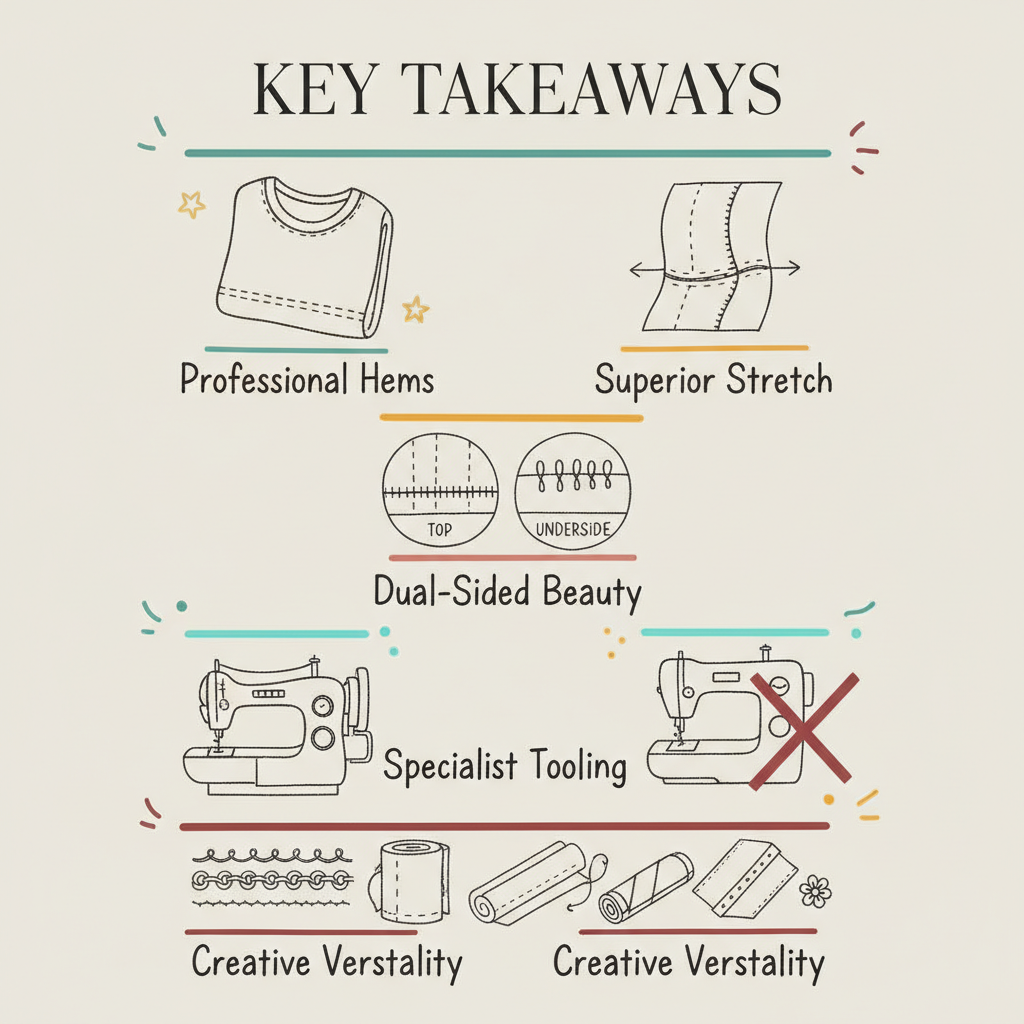
- Professional Hems: Understanding what does a coverstitch do reveals the secret to store-quality finishes on t-shirts and activewear.
- Superior Stretch: A coverstitch provides essential elasticity, ensuring seams do not pop when the fabric is pulled or worn.
- Dual-Sided Beauty: Learning what does a coverstitch look like helps you identify the distinctive parallel topstitching and looper underside.
- Specialist Tooling: Knowing what does a coverstitch sewing machine do distinguishes it from a standard overlocker or domestic machine.
- Creative Versatility: Beyond basics, exploring what can you do with a coverstitch machine opens doors to decorative chainstitching and binding.
The Journey to Professional Perfection
There is a specific moment in every sewist’s journey—perhaps while you are attending sewing classes London for beginners or finishing your first jersey dress at home—where you look at your hem and notice it doesn’t quite match the clothes in your wardrobe. You might have used a twin needle or a zig-zag stitch, but the finish lacks that crisp, industrial “bounce.” This is the moment you begin to wonder: what can a coverstitch machine do to elevate my work?
As your tutor, I often see students reach this crossroads. You have mastered the basics of how to sew, and your confidence is growing. You are no longer just making “home-made” clothes; you are crafting a bespoke wardrobe. To bridge that final gap between amateur and professional, we must look at specialist machinery. While a standard sewing machine is your versatile workhorse, a coverstitch machine is your specialist finisher.
In our sewing classes North London, we celebrate the “finished” look. It is the difference between a garment that looks like a craft project and one that looks like a high-end boutique find. Let us explore the magic of this machine together, with the patience and detail your creative journey deserves.
Defining the Finish: What Does a Coverstitch Do?
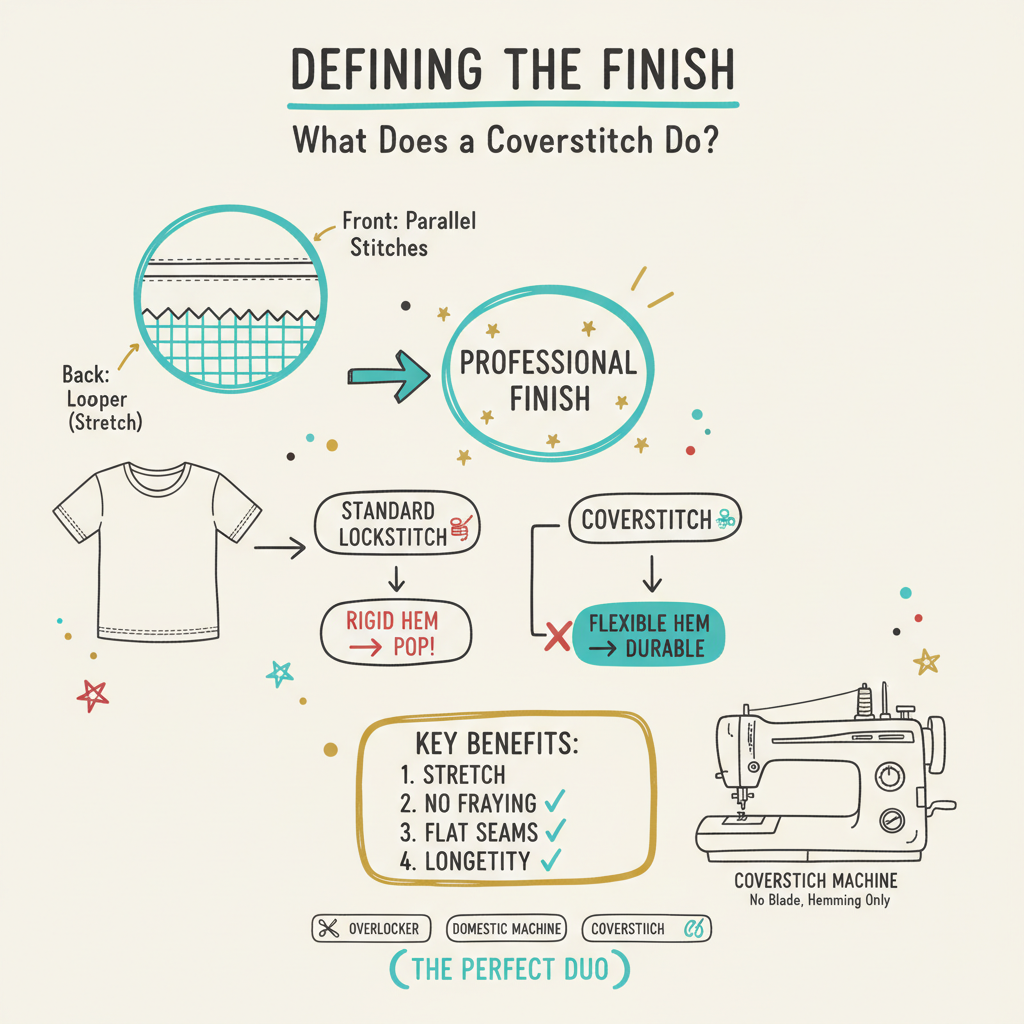
To understand the value of this investment, we must first ask: what does a coverstitch do that my other machines cannot? In its simplest form, a coverstitch machine is designed to hem knit fabrics while maintaining their stretch.
Unlike a standard lockstitch from a domestic machine, which is rigid, a coverstitch creates a loop of thread on the underside. This looper thread allows the seam to expand and contract along with the fabric. If you have ever put on a t-shirt and heard the “pop” of a hem snapping, it is likely because it was sewn with a non-stretchy stitch. The coverstitch eliminates this frustration, providing a professional, durable, and flexible finish that moves with your body.
The Secret to Longevity
Beyond just aesthetics, what does a coverstitch machine do for the lifespan of your clothes? It encapsulates the raw edge of the fabric on the underside while simultaneously stitching the hem in place. This prevents fraying and ensures that even after dozens of washes, your hems remain flat, secure, and looking brand new.
Visual Identity: What Does a Coverstitch Look Like?
If you were to walk into a high-street shop and turn a t-shirt hem inside out, you would see exactly what does a coverstitch look like. On the “right” side (the front of the garment), it typically appears as two or three perfectly parallel rows of straight stitching. These rows are impeccably spaced and look much cleaner than the slight wobbles often produced by a twin needle on a domestic machine.
On the “wrong” side (the inside), the magic happens. You will see a grid-like or “laddered” pattern of interlocking threads. This is the looper thread. It covers the raw edge of the fabric—hence the name “coverstitch.” If you are curious about what does a coverstitch sewing machine do differently, look at the underside; it provides a comprehensive “overlocked” finish that a standard sewing machine simply cannot replicate.
Understanding the Tool: What Does a Coverstitch Machine Do?
It is common for those in London sewing courses for adults to confuse a coverstitch machine with an overlocker (serger). While they look similar, their functions are distinct. So, what does a coverstitch sewing machine do that an overlocker doesn’t?
An overlocker is designed to join two pieces of fabric together while cutting off the seam allowance. A coverstitch machine, however, does not have a blade. It is used primarily on a single layer of fabric that has been folded over to create a hem. It creates a professional finish on the edge without cutting anything away.
In our intermediate London sewing courses for adults, we often use both in tandem. You might construct the garment on the overlocker and then move to the coverstitch for the neckline, sleeve cuffs, and bottom hem. It is the ultimate duo for anyone serious about working with jerseys, sweatshirt fabrics, or athletic wear.
Creative Potential: What Can You Do with a Coverstitch Machine?
Once you have mastered the basics, you will begin to ask: what can you do with a coverstitch machine beyond just hemming? The versatility of this machine is often underestimated.
- Decorative Chainstitching: By using only one needle, you can create a beautiful chainstitch. This is perfect for decorative topstitching on denim or for creating removable “basting” lines.
- Attaching Binding: With a binder attachment, your machine can wrap a strip of fabric around a raw edge (like a neckline) and stitch it down perfectly in one pass.
- Flat-felled Seams: You can use the machine to create decorative flat seams on the outside of garments, a popular look in activewear and “athleisure.”
- Elastic Attachment: It is excellent for sewing elastic directly onto fabric, as the stitch will stretch perfectly with the elastic without snapping.
When you learn to use a sewing machine, you start with the “how.” When you move to a coverstitch, you start with the “why”—why do I want this finish, and how can I make this garment look truly world-class?
Our Unique Insight: The “Tension Harmony” Technique
In my years of providing private sewing lessons London, I have noticed that the biggest hurdle with coverstitch machines isn’t the threading—it’s the tension. Most students treat tension as a set-it-and-forget-it dial. However, at our sewing classes North London, I teach the “Tension Harmony” technique.
Because a coverstitch uses so much thread in its looper, the balance between the top needles and the bottom looper is delicate. My unique insight is this: always “over-thread.” If you feel the stitch is too tight, don’t just turn the dial; check that the thread is seated deeply in the tension discs. Often, a “bad” stitch is simply a thread that hasn’t “clicked” into place. By learning to feel the resistance of the thread as you pull it through, you gain a sense of control that no manual can provide. It is this tactile intuition that transforms a student into a master.
Actionable Strategy: The Pro-Hem Checklist
If you are ready to experiment with professional finishes today, follow this actionable strategy. You don’t need a coverstitch machine to start thinking like a pro; you can apply these rules to your current seamstress courses work:
- The Pressing Rule: Never hem a knit fabric without pressing the fold first. Use a hem gauge to ensure it is perfectly even (usually 2cm or 2.5cm for t-shirts).
- The Stabiliser Secret: If your fabric is very fine or “slinky,” use a wash-away stabiliser or a hem tape. This prevents the “tunnelling” (the ridge between the two lines of stitching) that can occur on coverstitch machines.
- The Tail-End Technique: When finishing a coverstitch, you cannot simply backstitch. You must pull the top threads through to the back and tie them off manually to prevent the chain from unraveling.
- Test Your Stretch: Before sewing your final garment, sew a 10cm test strip. Pull it hard. If the thread breaks, your tension is too tight or your stitch length is too short.
Enhancing Your Skills: Different Types of Sewing Machine
As you broaden your horizons, you will realise that your sewing room can become a sanctuary of specialist tools. When students ask what are different types of sewing machine, they are often looking for the next step in their education.
- The Domestic Machine: Your starting point for all sewing classes London for beginners. Great for buttonholes and woven fabrics.
- The Overlocker: The next step for anyone who loves making clothes. It finishes seams and handles knits beautifully.
- The Coverstitch: The final piece of the puzzle for professional garment finishing.
- The Heavy-Duty Machine: Essential if you want to how to sew and alter clothes made of leather, denim, or heavy canvas.
Each machine has a personality. In our private sewing lessons London, we help you find the machine that matches your creative voice.
Frequently Asked Questions (FAQ)
What does a coverstitch machine do that a twin needle can’t?
While a twin needle on a standard machine mimics the look of a coverstitch, it lacks the looper thread on the back. A twin needle creates a zig-zag on the underside which often results in “tunnelling”—where the fabric bunches up into a ridge. A coverstitch machine remains flat and provides much more “give” or stretch, ensuring the hem doesn’t snap when the garment is under tension.
Do I really need a coverstitch machine for my sewing blog projects?
If you primarily sew woven fabrics like cotton or linen, a coverstitch isn’t necessary. However, if your sewing blog focuses on modern wardrobes, t-shirts, leggings, or swimwear, a coverstitch machine is a game-changer. It significantly reduces the time spent hemming and provides a finish that is indistinguishable from professional ready-to-wear clothing, which is vital for high-quality content.
What does a coverstitch look like on different fabrics?
On lightweight jerseys, it looks like two delicate, flat rows of stitching. On thicker fabrics like fleece or French Terry, you can use a three-needle “wide” coverstitch for a sportier, more robust look. You can also flip the fabric and sew with the looper side facing up for a decorative, industrial “flatlock” effect often seen on high-end sweatshirts and gym gear.
Is it difficult to learn how to use a coverstitch sewing machine?
It requires a bit more patience than a standard machine, especially regarding threading and tension. However, in our sewing classes London for adults, we find that once a student understands the “path” of the thread, it becomes second nature. The key is to practice on scraps and learn how to secure the ends of the stitches, as they do not backstitch like regular sewing machines.
Conclusion
The transition from beginner to intermediate sewist is marked by a growing appreciation for the “unseen” details. Understanding what does a coverstitch do is a vital part of that growth. It represents a commitment to quality, durability, and professional standards. Whether you are browsing a sewing blog for inspiration or looking to enrol in intermediate London sewing courses for adults, remember that your tools are there to support your vision.
A coverstitch machine is more than just a hemming tool; it is an invitation to explore the world of high-stretch fabrics and professional tailoring. As you continue your creative journey, stay curious, stay patient, and never be afraid to invest in the skills and tools that make your handmade wardrobe shine.
About the Author: Grace, Founder of London Sewing Courses
Grace is the heart and hands behind London Sewing Courses. A passionate and experienced sewing instructor, she founded the studio with a unique mission: to create a calm, friendly space for adults to learn and connect, while using the profits to fund free sewing classes for local children in need. Her personal expertise and commitment to community building are at the core of every class and every stitch.
Sources
- Seamwork: Do I Really Need a Coverstitch Machine?
- Threads Monthly: What is a Coverstitch Machine?
- London Sewing Courses: Guide to Professional Finishing (https://londonsewingcourses.co.uk/sewing-blog/)