Tag: quilting tools

  • Quilter’s Choice: Finding the Perfect Machine for Quilting

    Quilter’s Choice: Finding the Perfect Machine for Quilting

    Key Takeaways

    • Throat Space is King: The distance between the needle and the machine body (the throat) is the most critical feature for managing large quilts.
    • Stitch Regulation Matters: For beautiful free-motion work, a stitch regulator ensures your stitches stay a consistent length regardless of how fast you move the fabric.
    • Specialist Brands Lead the Way: Bernina and Janome offer dedicated “Quilters Edition” models with superior tension and stability.
    • Evolution of Equipment: Beginners can start on domestic machines, but serious makers often progress to sit-down or stand-up long-arm machines for ultimate control.
    Key takeaways infographic for what is the best sewing machine for free motion quilting

    Hello there, lovely maker. If you’ve ever found yourself wrestling with a heavy quilt sandwich under a tiny sewing machine arm, you know that quilting is as much about the tools as it is about the talent. Whether you are dreaming of intricate free-motion swirls or simply want a machine that won’t protest at three layers of batting, choosing the right partner for your creative journey is a big step.

    At London Sewing Courses, we often see students transition from basic dressmaking to the expansive world of quilting. It is a joyful shift, but one that requires a bit more “breathing room” from your equipment. Let’s walk through the wonderful options available to you, with the patience and care your projects deserve.
    What is Quilting in Sewing?

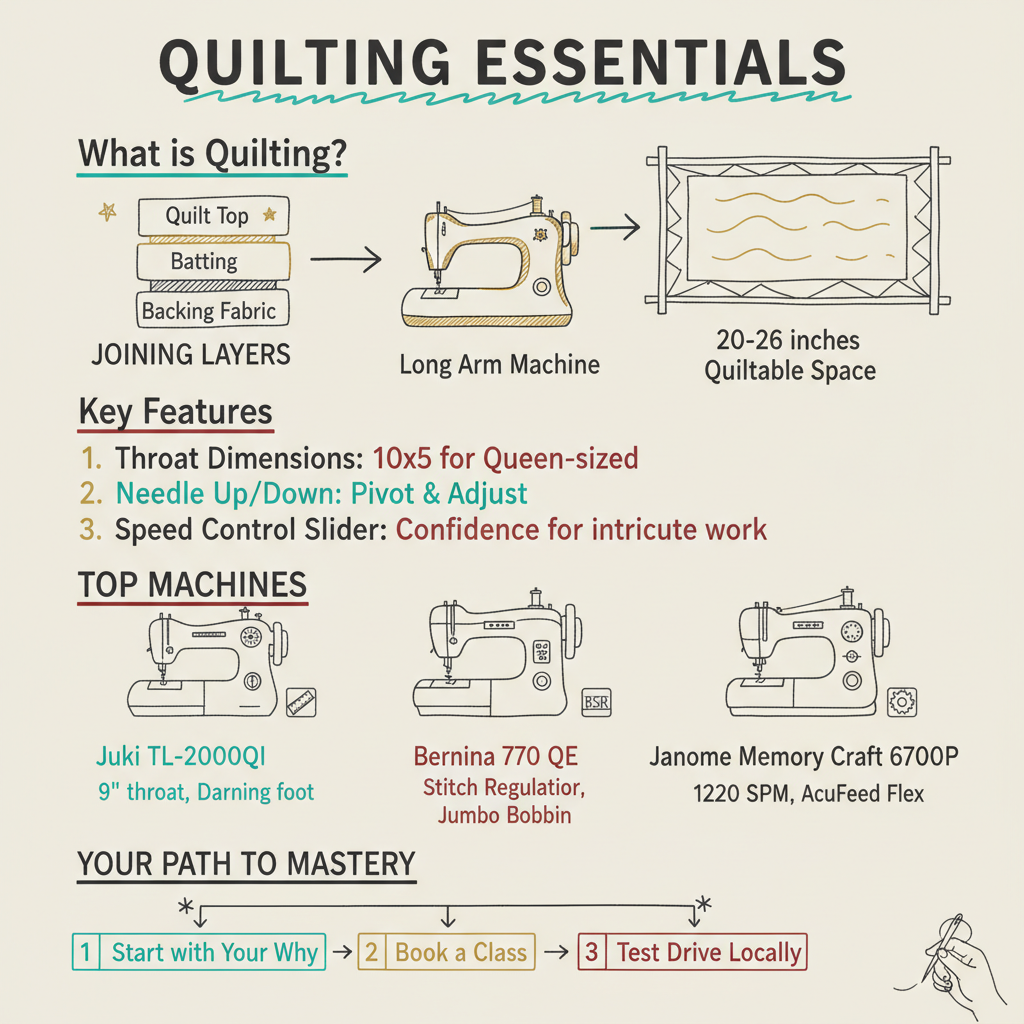
    Before we dive into the technicalities, let’s settle a common question: what is quilting in sewing? At its simplest, quilting is the process of joining three layers together—the quilt top (the pretty part!), the batting (the fluffy middle), and the backing fabric.

    A quilting sewing machine is specifically designed to handle this “sandwich”. While a standard machine focuses on precision for single or double layers, a quilting machine prioritises power, speed, and, most importantly, space.

    The Secret to Success: What is a Long Arm Sewing Machine?

    In your research, you will likely come across the term “long-arm.” But what is a long arm sewing machine exactly? In the world of domestic sewing, it refers to a machine with an extended throat—usually 8 to 12 inches.

    For professional-grade work, a true long-arm is a specialist machine where the head moves over the fabric on a frame, rather than you moving the fabric under the needle. This provides a “quiltable space” of 20 to 26 inches, allowing you to finish king-sized masterpieces without ever having to “scrunch” your fabric.

    Best Sewing Machine for Free Motion Quilting

    Free-motion quilting (FMQ) is where you drop the feed dogs (those little metal teeth) and guide the fabric yourself in any direction. It’s like drawing with thread!

    The best sewing machine for free motion quilting must offer two things: visibility and a smooth “glide”.

    • Juki TL-2000Qi: Often cited as a “straight-stitch workhorse,” this machine offers a generous 9-inch throat and a dedicated darning foot for FMQ.
    • Brother HC1850: A wonderful all-rounder for those starting out, offering easy-to-use free-motion options at a more accessible price point.
    • Baby Lock Radiance: A premium choice that includes built-in sensors to track your fabric movement, making the learning curve much gentler for beginners.

    The Elegance of Engineering: Best Bernina Sewing Machine for Quilting

    Bernina machines are often considered the “heirloom” choice for quilters. They are robust, quiet, and offer some of the most innovative technology in the industry.

    The Bernina 770 QE (Quilters Edition)

    This is widely regarded as the best Bernina sewing machine for quilting.

    • Bernina Stitch Regulator (BSR): This is the magic ingredient. The BSR foot communicates with the machine to keep every stitch perfectly even, no matter how much your hands speed up or slow down.
    • Extended Free Arm: It provides 10 inches of space to the right of the needle, which is a luxury for managing bulky projects.
    • Jumbo Bobbin: It holds 70% more thread than a standard bobbin, meaning fewer interruptions during those long quilting sessions.

    For those looking for a dedicated sit-down experience, the Bernina Q16 or Q24 long-arm machines offer professional-level digital tension and a sturdy frame that won’t vibrate as you work.

    Reliability and Reach: Best Janome Sewing Machine for Quilting

    The Janome Memory Craft 6700P

    For many, this is the best Janome sewing machine for quilting.

    • Industrial Speed: With speeds up to 1,200 stitches per minute, you can finish quilt tops at an alarming rate.
    • Wide Throat Space: It offers one of the largest workspaces in its class, perfect for “shoving and pulling” your quilts during free-motion work.
    • AcuFeed Flex: This dual-feed system ensures that all layers of your quilt sandwich move together perfectly, preventing the dreaded “puckering” on the back.

    Going Big: The Best Long Arm Sewing Machine

    If you have the space and the passion to turn your hobby into a craft business, a frame-mounted long-arm is the ultimate investment.

    • HandiQuilter Amara: An excellent choice for “serious beginners” and professionals alike. It offers 20 to 24 inches of throat space and a 7-inch touch screen that makes toggling between precision and cruise modes effortless.
    • Bernina Q24: Known for its “digital tension,” which takes the guesswork out of getting the perfect stitch on both sides of your quilt. Its hydraulic lift frame also means you can adjust the height to protect your back during long sessions.

    Features to Look For: A Tutor’s Checklist

    When you visit a shop to “test drive” a machine (which I highly recommend!), keep these features in your mind:

    1. Throat Dimensions: Measure the height and width. A 10″ x 5″ throat is a dream for queen-sized projects.
    2. Needle Up/Down: A must-have for quilting. It allows you to stop with the needle in the fabric, so you can pivot or adjust your quilt without losing your place.
    3. Speed Control Slider: Especially for beginners, being able to limit the top speed gives you much more confidence during intricate work.
    4. Extension Table: This supports the weight of your quilt, preventing it from pulling on the needle and distorting your stitches.

    Actionable Strategy: Your Path to Quilting Mastery

    If you are feeling overwhelmed by the choices, remember that every master was once a beginner. Here is how I suggest you proceed:

    • Start with your “Why”: Are you making small wall hangings or king-sized bedspreads? This dictates how much throat space you truly need.
    • Test Drive Locally: Visit a dealer in North London. Sit at the machine, thread it yourself, and listen to the motor. You want a partner that feels “solid” and quiet.

    Frequently Asked Questions (FAQ)

    Yes, you absolutely can!. However, you will need a walking foot and a bit of patience for rolling up the fabric to fit through the smaller throat. For more tips, check our guide on how to use a sewing machine.

    If you find yourself quilting several large tops a year, a long-arm will save your back and shoulders significant strain. It also allows for much more fluid and professional-looking free-motion designs.

    The Janome 3160 QDC or the Brother CS7000X are excellent budget-friendly options that include the necessary quilting feet and a wide table to get you started without a massive investment.

    Conclusion

    Finding the “perfect” machine is a personal journey. Whether you choose the precision of a Bernina, the speed of a Janome, or the freedom of a long-arm, the most important thing is that it makes you want to sew.

    About the Author: Grace, Founder of London Sewing Courses

    Grace is the heart and hands behind London Sewing Courses. A passionate and experienced sewing instructor, she founded the studio with a unique mission: to create a calm, friendly space for adults to learn and connect, while using the profits to fund free sewing classes for local children in need. Her personal expertise and commitment to community building are at the core of every class and every stitch.

    Sources

  • What is a Singer Featherweight Sewing Machine?

    What is a Singer Featherweight Sewing Machine?

    Key Takeaways

    • Portability and Precision: Weighing only 11lbs (5kg), the Featherweight remains the gold standard for portable, high-quality stitching.
    • Mechanical Excellence: These machines feature a unique rotary hook system and all-metal internal gears, ensuring decades of reliable performance.
    • Investment Value: Unlike modern plastic models, a well-maintained or refurbished machine often appreciates in value over time.
    • Versatility: It excels at straight-stitch tasks, making it a favourite for quilters and those attending garment construction workshops.
    Key takeaways infographic for what is a singer featherweight sewing machine what is a singer sewing machine, what is best sewing machine for home use, what is a portable sewing machine, what is a refurbished sewing machine, what is better a singer or brother sewing machine

    The question of what is a Singer Featherweight sewing machine often arises when a student first sees a small, black, glistening machine tucked away in a beautiful vanity case. For many, it looks like a toy, but for the seasoned seamstress, it represents the pinnacle of 20th-century engineering. The Featherweight, specifically the Model 221 and later the 222K, is a dedicated straight-stitch machine produced between 1933 and the late 1960s. It was designed to offer the power of a heavy industrial unit in a frame that a person could easily carry to a friend’s house or a local seamstress courses session.

    The UK market, particularly in London, has seen a massive resurgence in these machines. As we move away from “fast fashion” and towards sustainable, handmade wardrobes, having a tool that is both beautiful and functional is a joy. If you are a beginner wondering how to sew, you might find that the simplicity of a mechanical vintage machine is far less intimidating than a modern computerised screen.

    The subsequent sections will explore why this specific model changed the landscape of domestic sewing, how it compares to modern rivals, and why it might be the best companion for your creative journey.

    Infographic about what is a singer featherweight sewing machine for London Sewing Courses

    The Simple Answer: Why Weight Matters

    The Singer Featherweight was born during the Great Depression, a time when households needed tools that were durable yet compact for smaller living spaces. Its “feather” weight comes from its cast-aluminium body, a revolutionary departure from the heavy cast-iron machines of the Victorian era.

    When you ask what is a Singer sewing machine meant to do, the answer is usually “last forever.” The Featherweight embodies this. Because it only performs a straight stitch, it does that one thing perfectly. There are no complicated plastic cams to snap or electronic motherboards to fry. This reliability is why you will still see them being used in high-end sewing classes London for adults today.

    Singer vs. Brother: The Vintage Debate

    Many students ask me, what is better a singer or brother sewing machine? The answer depends entirely on your goals. If you require hundreds of decorative embroidery stitches and automatic buttonholes, a modern Brother machine is a fantastic, user-friendly choice. However, if you value stitch tension, historical soul, and a machine that you can actually repair yourself, the Singer Featherweight wins every time.

    Modern machines often use a “drop-in” bobbin made of plastic, which can lead to bird-nesting of threads if not timed perfectly. The Featherweight uses a side-loading metal bobbin case and a precision rotary hook. This provides a “lockstitch” so tight and even that it is often indistinguishable from professional factory work. For those enrolled in sewing classes London for beginners, the tactile feedback of a vintage Singer helps you understand the mechanics of thread tension far more deeply than an automated machine would.

    Expertise and Authority: The True ‘Qualification’ of a Tool

    The authority of the Featherweight comes from its track record. It isn’t just a hobbyist’s tool; it was the machine of choice for many professional dressmakers who needed to travel to clients’ homes. At our London sewing courses, we often see students bring in heirlooms that haven’t been oiled in forty years. With a little bit of kerosene and some sewing machine oil, they roar back to life.

    If you are looking for what is best sewing machine for home use, consider the space you have. A Featherweight fits on a tiny desk, or even a kitchen table, and can be tucked into a wardrobe when not in use. This makes it ideal for city living where a dedicated sewing room is a luxury.

    Our Unique Insight: Vintage Value – The History and Revival

    If you’re wondering about the longevity of this machine, it’s helpful to look at it as a piece of “functional art.” Most modern appliances are designed with “planned obsolescence”—they are meant to be replaced every five to ten years. The Singer Featherweight was designed for the opposite.

    The recent revival of interest in these machines isn’t just nostalgia. It’s a reaction against the disposable nature of modern technology. In my experience, a student who learns on a vintage machine develops a better “feel” for the fabric. You hear the motor, you feel the resistance of the handwheel, and you become a more intuitive maker. This connection is why the Featherweight has become a cult object in the quilting community.

    Distinguishing Your Machine: New, Used, or Refurbished?

    When shopping for a vintage machine, you will encounter various terms. Understanding these will save you a great deal of frustration and money.

    What is a Refurbished Sewing Machine?

    A refurbished sewing machine is one that has been stripped down to its core components, cleaned, re-oiled, and timed by a professional. In the context of a Featherweight, this often includes:

    • Rewiring: Replacing old, brittle power cords for safety.
    • Motor Service: Cleaning the carbon brushes and adding fresh lubricant to the grease wicks.
    • Cosmetic Touch-ups: Polishing the “japanned” black finish and gold decals.

    Buying a refurbished model is often wiser than finding a “bargain” at a car boot sale that may require hundreds of pounds in parts. If you are serious about your craft, private sewing lessons London can help you determine if your specific machine is performing at its peak.

    Actionable Strategy: Five Steps to Buying a Featherweight Today

    To bridge the gap between “wanting” a vintage machine and actually owning a reliable one, follow these steps:

    1. Check the Serial Number: Singer machines have a letter and number code on the base. You can look this up online to find the exact day and factory where your machine was born.
    2. Test the Handwheel: It should turn toward you with almost zero resistance. If it feels “gummy,” the old oil has hardened into a varnish.
    3. Inspect the Wiring: Never plug in a vintage machine without checking the motor wires for cracks. Fire safety is paramount.
    4. Look for the Case: An original “black box” carrying case adds significant value to the machine and protects it from dust.
    5. Search for Accessories: The original “Greist” attachments (like the ruffler or tucker) are engineering marvels. Ensure the bobbin case is included, as these can be expensive to replace ($30-$80).

    Actionable Strategy: How to Maintain Your Machine

    Most people assume that how to learn to use a sewing machine starts with threading. Actually, it starts with maintenance.

    • Oil Every 8 Hours: Unlike modern machines that are “self-lubricating” (which usually means they can’t be oiled), the Featherweight needs a drop of oil in specific points every few hours of use.
    • Use Only “Sewing Machine Oil”: Never use WD-40 or 3-in-1 oil. These will ruin the delicate internal tolerances.
    • Brush Out the Lint: Remove the needle plate after every project and use a small brush to clear out the dust from the feed dogs.

    If you are looking for more tips on keeping your equipment in top shape, check our Sewing blog for deep dives into vintage care.

    The Practical Path: Transitioning to Advanced Skills

    Once you have mastered your machine, you may find yourself wanting to tackle more complex projects. The Featherweight is surprisingly capable here. While it doesn’t have a free arm for sleeves, its small footprint allows you to manipulate fabric quite easily.

    For those ready to move beyond basic cushions and tote bags, London sewing courses for adults can teach you how to use your vintage machine for garment construction, tailoring, and even light upholstery. The key is understanding that what is a portable sewing machine‘s greatest strength—its size—can also be its challenge when working with heavy winter coats or bridal gowns.

    Filling the Ranks: Joining the Community

    Finding a community is the best way to grow. The “Featherweight Club” is a global network of enthusiasts.

    • Online Forums: Groups on Facebook and Reddit offer instant troubleshooting if your tension goes wonky.
    • Local Meetups: Many London studios offer “social sewing” days where you can bring your machine and share tips with others.
    • Workshops: Look for specific “Vintage Machine” workshops at Sewing Classes North London to learn the quirks of your 221.

    Addressing the Investment: Is a Featherweight Worth It?

    From a financial perspective, the question of value is clear. A new “cheap” machine from a supermarket might cost £150 and have a lifespan of three years. A Singer Featherweight might cost £400 to £800 but will last another century if cared for.

    Parents often ask me if they should buy a “junior” machine for their children. I always suggest a vintage Singer instead. The metal parts are more forgiving, and the slower speed of the older motors is actually safer for little fingers to manage.

    Frequently Asked Questions (FAQ)

    A portable machine, like the Singer Featherweight, is designed specifically for mobility without sacrificing stitch quality. While standard domestic machines of the 1930s were built into heavy wooden cabinets or desks, the Featherweight features a fold-up extension table and a lightweight aluminium frame. This allows the user to store the machine in a small case, making it ideal for those with limited space or those who travel.

    Neither is objectively “better,” as they serve different purposes. A vintage Singer is a mechanical masterpiece built for durability and a perfect straight stitch. It is ideal for quilting and basic garment construction. A modern Brother machine offers versatility, including zig-zag stitches, buttonholes, and decorative embroidery. If you want a machine that is easy to repair and holds its value, choose the Singer; for modern features, choose Brother.

    The Singer Featherweight is surprisingly powerful for its size, but it is not an industrial machine. It can handle several layers of denim or light leather if you use the correct needle and go slowly. However, consistently sewing very heavy materials can strain the small motor. For heavy-duty projects, it is better to use a dedicated industrial machine or a larger vintage model like the Singer 201 or 15-91.

    Check the “japanning” (the black paint) for chips and the gold decals for wear. Use a grading scale: “Mint” machines look brand new, while “Fair” machines have significant cosmetic damage. Mechanically, the machine should run smoothly without any grinding noises. Ensure the light works and the foot pedal doesn’t get excessively hot. A well-maintained machine should produce a balanced stitch on both the top and bottom of the fabric immediately.

    Conclusion

    The answer to the initial question—what is a Singer Featherweight sewing machine?—is that it is more than just an appliance. It is a bridge to a time when things were built to last and a tool that empowers modern creativity. Whether you are a beginner or an expert, its combination of beauty, portability, and precision is unmatched in the sewing world.

    If you have the passion to create, the commitment to learn, and a love for fine engineering, the world of vintage sewing is waiting for you. From your first stitch to your first handmade garment, a Featherweight is a companion that will never let you down. If you’re in the capital and want to start your journey, don’t hesitate to reach out for a Contact and join our community of makers.

    About the Author: Grace, Founder of London Sewing Courses

    Grace is the heart and hands behind London Sewing Courses. A passionate and experienced sewing instructor, she founded the studio with a unique mission: to create a calm, friendly space for adults to learn and connect, while using the profits to fund free sewing classes for local children in need. Her personal expertise and commitment to community building are at the core of every class and every stitch.

    Sources