Tag: beginner sewing lessons

  • What is a Quarter Inch Sewing Machine Foot and Other Essential Attachments

    What is a Quarter Inch Sewing Machine Foot and Other Essential Attachments

    Key Takeaways

    • Precision is Paramount: Specialty feet like the quarter inch foot are essential for accurate seam allowances in quilting and garment construction.
    • Functional Variety: From what is a zipper foot used for to the complexities of a shirring foot, each attachment serves a unique structural purpose.
    • Professional Finishes: Using tools like an invisible zipper foot or overcast presser foot elevates home-made projects to retail quality.
    • Creative Expansion: Understanding what is a wing needle for sewing machines allows for decorative heirloom techniques like entredeux.

    The world of sewing often feels like a beautiful, intricate puzzle. When you first sit down at your machine, the array of small metal attachments can seem a little daunting. However, these tools are your best friends in the studio. They transform your machine from a simple stitching tool into a versatile instrument capable of high-end tailoring and delicate craft. Whether you are attending sewing classes North London or stitching away at home, knowing which foot to click into place is the first step toward mastery.

    Perhaps you have looked at your accessory box and wondered, “what is a quarter inch sewing machine foot?” or puzzled over the difference between a piping foot and a welting foot. Each of these attachments has been engineered to solve a specific problem—be it keeping a seam perfectly straight or gathering fabric into soft, even ruffles. This guide will walk you through the most essential specialty feet, ensuring you feel confident and inspired to tackle your next project.

    The Foundation of Precision: The Quarter Inch Foot

    If you have ever dreamt of making a quilt, you have likely encountered the term “scant quarter inch.” Achieving this level of accuracy by eye is nearly impossible, which is where the quarter inch foot comes in.

    What is a Piecing Foot?

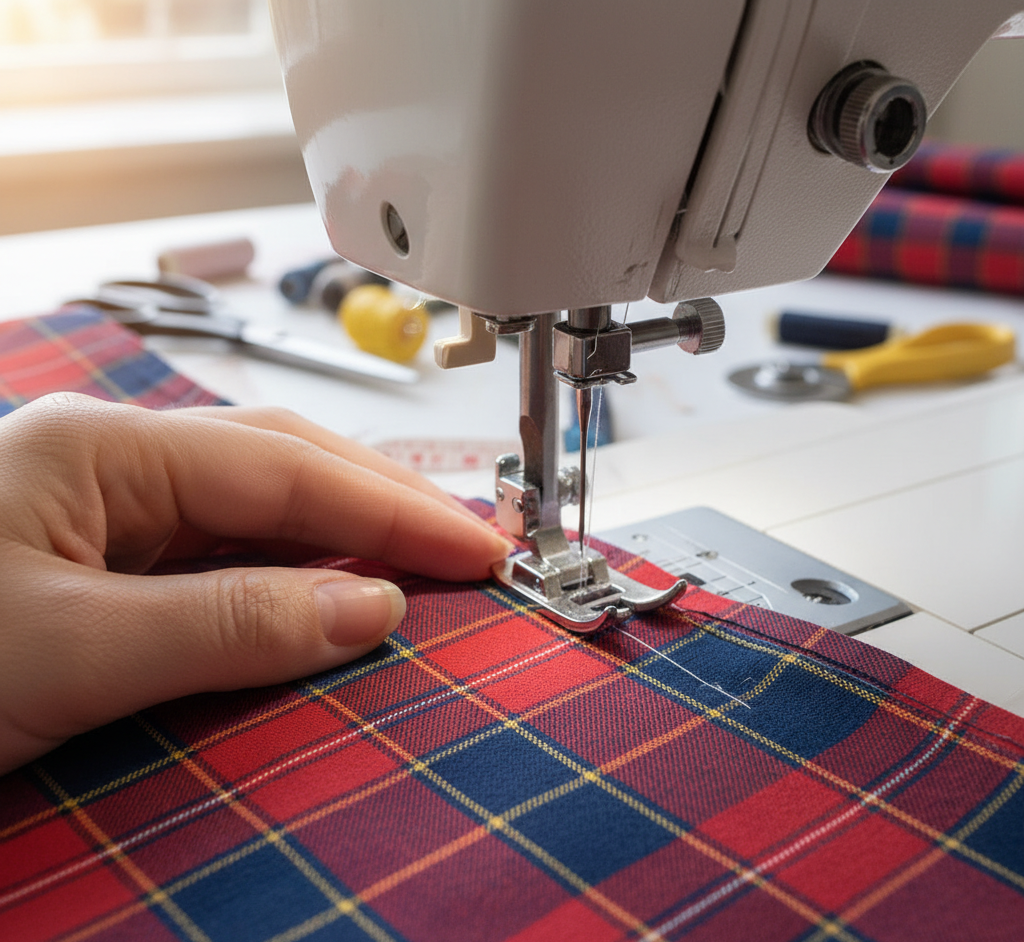
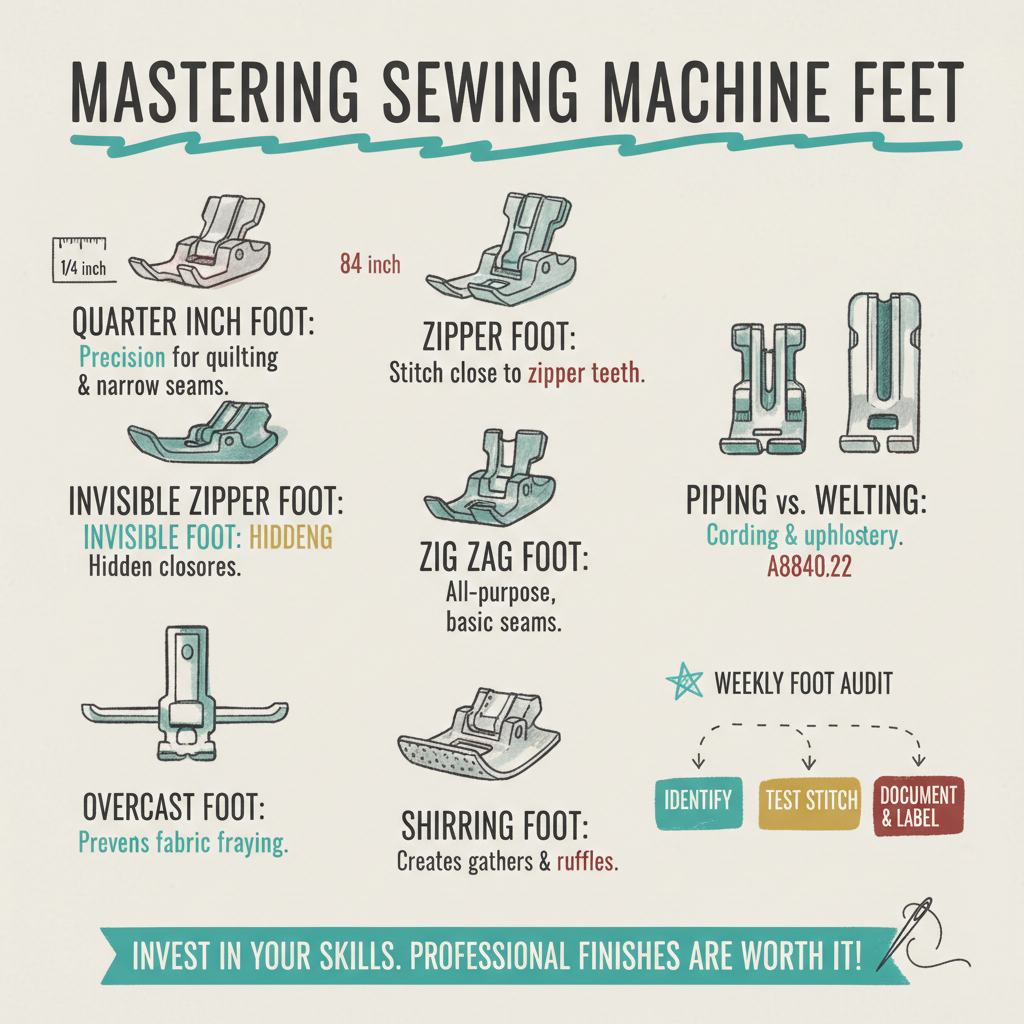
    Often referred interchangeably as a piecing foot, this attachment is the gold standard for quilters. The distance from the needle to the edge of the foot is exactly 1/4 inch. By aligning the raw edge of your fabric with the right-hand edge of the foot, you ensure every seam is uniform. This precision is vital because even a millimetre of error can result in a quilt block that doesn’t lay flat or line up correctly at the corners.

    Improving Your Accuracy

    Many versions of this foot come with a small metal flange or “guide” on the right side. This guide prevents the fabric from drifting, making it an excellent tool for beginners who are still developing their steady hand. Beyond quilting, this foot is incredibly useful for topstitching narrow hems or creating precise seam allowances on delicate doll clothes or intricate garment details.
    Mastering Fasteners and Closures

    Zippers are often the most feared part of a beginner’s journey. However, the right equipment removes the stress entirely.

    What is a Zipper Foot Used For?

    The standard zipper foot is designed with notches on both the left and right sides. This allows the needle to stitch very close to the zipper teeth or “coils” without the foot riding over them. Because the foot is narrow, you can adjust your needle position to get as close as necessary to the edge of the zipper tape. It is a versatile tool that every sewist should master early on.

    What is an Invisible Zipper Foot?

    If you want your fastenings to disappear into the seam of a dress or skirt, you need an invisible zipper foot. Unlike a standard version, this foot features grooves on the underside. These grooves “unroll” the zipper coils as you sew, allowing the needle to stitch right in the “ditch” of the zipper tape. When done correctly, the zipper becomes entirely hidden within the seam line.

    Professional Edges and Finishes

    Not everyone owns an overlocker, but that shouldn’t stop you from achieving a professional finish on your raw edges.

    What is an Overcast Presser Foot Used For?

    An overcast presser foot (sometimes called an overedge foot) is designed to wrap thread around the edge of the fabric to prevent fraying. It features a small bridge or bar in the centre that keeps the fabric flat and prevents the stitches from pulling the edge into a bunch. When used with an overcasting stitch on your domestic machine, it mimics the look of a professional serged edge.

    What is a Zig Zag Foot?

    The zig zag foot is likely the one currently on your machine. It is the “all-purpose” attachment with a wide opening to accommodate the side-to-side movement of the needle. While it is perfect for basic seams, using it for specialized tasks can sometimes lead to fabric tunneling or skipped stitches. It is always better to swap to a dedicated foot when the task becomes more specific.

    Decorative and Structural Specialty Feet

    As you progress to London sewing courses for adults, you will encounter techniques that require even more specialized hardware.

    What is a Piping Foot vs. a Welting Foot?

    The distinction between a piping foot and a welting foot often causes confusion. A piping foot usually has a single groove on the underside to accommodate the corded trim used in garment making. A welting foot, often used in upholstery, usually features two grooves. This allows you to sew closely to the cord and then sew that cord to the main fabric piece in a subsequent pass, ensuring the cord stays perfectly aligned.

    What is a Shirring Foot?

    A shirring foot is a magical tool for creating gathers. It is designed with a specific sole that puts uneven pressure on the fabric, causing it to gather as you sew. You can even tuck a piece of fabric into the slot of the foot to gather the bottom layer while keeping the top layer flat—perfect for attaching ruffles to a skirt in a single step.

    Our Unique Insight: The Psychology of the “Right Tool”

    At our studio, we often notice that a student’s frustration rarely stems from a lack of talent; it usually comes from using the wrong attachment. We believe that learning how to sew is as much about mechanical literacy as it is about creative vision. When you understand the physics of how a foot holds fabric against the feed dogs, you stop fighting your machine and start collaborating with it. Using a specialized foot isn’t “cheating”—it is the mark of a professional who values their time and the quality of their craft.

    Actionable Strategy: Your Weekly Foot Audit

    To truly learn to use a sewing machine, you must get comfortable with its anatomy. Try this strategy this week:

    1. Identify Three Feet: Take three mystery feet from your accessory box that you have never used.
    2. Test Stitch: Use scrap fabric of different weights (cotton, denim, and silk) and try each foot.
    3. Document the Results: Note down which stitch settings worked best. For example, did the overedge foot work better with a wider or narrower stitch?
    4. Label Your Box: Use a small piece of masking tape to label the compartments in your accessory tray so you never have to guess again.

    Is Specialty Sewing Worth the Effort?

    When students ask if investing in extra feet is worth it, the answer is a resounding yes. The difference between a “homemade” garment and a “handmade” one often lies in the details—the perfectly straight topstitching from a quarter inch foot or the crisp edges provided by an overcast presser foot.

    The Value of Professional Instruction

    While YouTube is a great resource, nothing beats the immediate feedback of private sewing lessons London. A tutor can show you exactly how to position your hands and how to adjust the tension for a shirring foot in real-time. This hands-on guidance saves hours of unpicking and ensures your sewing blog worthy projects are successful on the first try.

    Investing in Your Skills

    Enrolling in sewing classes London for adults provides access to high-end machines and a library of specialty feet you might not want to purchase yet. It is a fantastic way to “try before you buy” while building a community of like-minded makers. Whether you are looking for sewing classes London for beginners or more advanced seamstress courses, the focus remains on building confidence through technical proficiency.

    Frequently Asked Questions (FAQ)

    What is a wing needle for sewing machines?

    A wing needle is a unique needle with wide, flat “wings” on the sides of the shank. As it enters the fabric, the wings push the threads aside to create a permanent hole. It is used for decorative heirloom sewing, such as entredeux or hemstitching. It works best on natural, crisp fabrics like linen or cotton batiste, where the weave can be easily manipulated.

    Can I use a zipper foot for piping?

    Yes, you can use a standard zipper foot for piping if you do not have a dedicated piping foot. By moving your needle to the far left or right, you can get quite close to the cord. However, a dedicated piping foot is better because the groove on the underside “locks” onto the cord, preventing it from slipping and ensuring a much more consistent result.

    How do I know if a foot fits my machine?

    Sewing machines generally fall into two categories: low shank and high shank. Most domestic machines are low shank. To check, lower your presser foot and measure from the centre of the screw hole to the needle plate. If it is about 1/2 inch, it is low shank; if it is 1 inch or more, it is high shank. Always check your manual before purchasing.

    Do I really need an overedge foot?

    While a standard zig zag foot can finish edges, an overedge foot provides much more control. The little pin in the middle of the foot prevents the fabric edge from curling or “tunneling” under the tension of the zig-zag stitch. If you want your garments to look professional and last through many washes, it is a very worthwhile, inexpensive investment.

    Conclusion

    The journey from a beginner to an expert maker is paved with small, technical milestones. Understanding what is a quarter inch sewing machine foot and how it differs from a piecing foot or an overedge foot is one of those crucial steps. These attachments are designed to take the guesswork out of your projects, allowing your creativity to flourish without the hindrance of technical errors.

    Whether you are joining us for intermediate London sewing courses or just starting your first project at home, remember that your machine is a powerful ally. By choosing the right foot for the job, you ensure that every stitch is a step toward a garment you can be proud of. From the tiny details of a wing needle to the structural necessity of a zipper foot, these tools are the keys to unlocking your full potential as a sewist.

    About the Author: Grace, Founder of London Sewing Courses

    Grace is the heart and hands behind London Sewing Courses. A passionate and experienced sewing instructor, she founded the studio with a unique mission: to create a calm, friendly space for adults to learn and connect, while using the profits to fund free sewing classes for local children in need. Her personal expertise and commitment to community building are at the core of every class and every stitch.

    Sources

  • Finding Your Perfect Match: What is a Good Serger for Beginners?

    Finding Your Perfect Match: What is a Good Serger for Beginners?

    Key Takeaways

    • No Stress on Skill Level: You don’t need a professional background to master an overlocker (serger). Modern machines are much easier to thread and use than older models.
    • Essential Features: The best beginner sergers feature colour-coded threading, differential feed, and adjustable stitch length/width. These simplify operation and prevent fabric distortion.
    • Top Beginner Brands: Juki and Brother are consistently recommended for their durability, value, and ease of use right out of the box, with Juki often providing a more ‘workhorse’ feel.
    • Differential Feed is Key: This feature is critical for professional-looking seams, preventing both stretching (on knits) and puckering (on fine fabrics).
    • Confidence is Built: Learning to use this machine effectively, perhaps through some dedicated seamstress courses, will completely transform the professional finish of your handmade garments.
    Doodle-style infographic summarizing key takeaways on what is a good serger for beginners, listing essential features, ease of use, and top brands like Juki and Brother.

    The jump from a traditional sewing machine to a serger (also known as an overlocker in the UK) can feel like a big one, even for experienced sewists. Suddenly, there are four threads, looping mechanisms, and a sharp blade, making the process look daunting. If you’ve been asking yourself, “What is a good serger for beginners?”, rest assured, you’re not alone.

    A serger is a specialist machine that simultaneously sews a seam, trims the excess fabric, and encases the raw edge with a strong, looped stitch. This is what gives high-street clothing that professional, clean finish that a standard sewing machine simply cannot replicate. This guide is designed to be your patient, skilled tutor, helping you understand the essential features, navigate the brand landscape, and confidently select the perfect entry-level model to elevate your sewing projects.

    Hand-drawn infographic visualizing essential serger features for beginners, including colour-coded threading paths, differential feed mechanics, and machine versatility options.

    Understanding the Serger: Essential Features

    Before we dive into specific models, you must understand the key features that separate a great beginner machine from one that will cause frustration. An overlocker’s value isn’t measured by the number of stitches it can perform, but by the quality and ease of its core functions.

    🧵 The Threading Revolution: Colour-Coding

    The biggest fear associated with a serger is threading. Older models required intricate manual manipulation, but modern entry-level machines have solved this.

    • Colour-Coded Path: Every good beginner serger will have the entire threading path for all four threads clearly marked with different colours (usually red, blue, green, and yellow).
    • Open Access: Look for a machine that allows the front cover to open wide, giving you unobstructed access to the lower looper, which is often the trickiest part.

    If a machine boasts “air-threading” or “self-threading,” it’s a huge bonus, though this feature often comes with a higher price tag.

    ⚙️ The Magic of Differential Feed

    This is perhaps the single most important feature to look for when considering what is a good serger. Differential feed refers to the machine’s ability to move the fabric with two sets of feed dogs—one in front of the needle and one behind it—moving at different rates.

    • Preventing Puckering: By setting the differential feed higher than 1.0 (e.g., 1.3 or 1.5), you can stretch the fabric slightly as it passes through, preventing wavy seams on stretchy knit fabrics.
    • Creating Gathers: Conversely, setting the differential feed lower than 1.0 (e.g., 0.7) can intentionally create a beautifully gathered effect on woven fabrics.

    A machine without this feature will make sewing knits, jersey, and fine fabrics incredibly frustrating, leading to stretched, unprofessional results.

    📏 Versatility and Control

    Your machine needs to be adaptable to different fabric types and project requirements.

    • Adjustable Stitch Length and Width: You should be able to easily adjust the length and width of the overlock stitch. A wider stitch (around 7mm) is ideal for heavy fabrics, while a narrower, shorter stitch is better for garment hems and fine materials.
    • The Knife Bypass: A crucial component that allows you to disengage or swing the cutting blade out of the way. This is essential when you want to use the overlock stitch purely for finishing a pre-cut edge without trimming any material.
    • Free Arm Capability: While less common on budget models, a free arm allows you to easily sew small, circular items like cuffs, sleeves, and necklines, significantly increasing the machine’s utility for garment making.

    Brand Wars: Finding the Best Entry-Level Machine

    When you ask seasoned sewists what is a good serger, a few brand names dominate the conversation. We’ll look at four major players, assessing them for a beginner’s needs, value, and overall performance.

    Juki: The Industrial Workhorse

    Juki was originally known for its industrial machinery, a reliability that translates beautifully into their domestic line. For many, Juki sergers are often regarded as the best value for money for a dedicated, high-quality machine. They are built to stand the test of time.

    • Top Pick: The Juki MO-654DE is universally recommended as an excellent entry-level serger. It offers the essential features—colour-coded threading, adjustable stitch length and width, and differential feed—in a reliable, easy-to-use package.
    • Pros: Exceptional stitch quality, highly durable, excellent tension control.
    • Cons: Can be louder and heavier than other brands. Threading the lower looper can still be a bit fiddly initially compared to air-threading models.

    Brother: The Beginner’s Best Friend

    Brother machines often shine in the entry-level market due to their emphasis on ease of use and affordability.

    • Top Pick: The Brother 1034D (or similar, widely available models) is a frequent suggestion for new serger users. It’s often highly recommended for its ease of use right out of the box.
    • Pros: Generally the most affordable option, very clear and simple threading guides, excellent included accessories.
    • Cons: Not as durable or robust as Juki for high-volume use; the quality of internal components can feel lighter. They can be a great starting point, but many serious sewists upgrade after a few years.

    Baby Lock: The Luxury Option

    If you’re wondering what is a babylock machine, you’re looking at the top end of the market. Baby Lock is renowned for its patented Jet-Air Threading system, which eliminates all threading fuss by using a puff of air.

    • Pros: Effortless, immediate threading—a huge time saver. Exceptional stitch quality and reliability.
    • Cons: Significantly more expensive than Juki or Brother models, often pricing them out of the entry-level budget. A beginner doesn’t necessarily need this luxury, but it certainly speeds up the learning curve.

    Singer and Pfaff: The Traditionalists

    While names like what is a good singer sewing machine or what is a pfaff sewing machine are synonymous with standard sewing, their sergers can be a mixed bag.

    • Singer: Their budget sergers are affordable but often lack the build quality and smooth operation of Juki or Brother. They are an option if budget is the absolute priority, but they may lead to more frustration.
    • Pfaff: Known for precision and high-quality construction, but their sergers tend to be pricier than their equivalents, pushing them towards the intermediate or advanced user.

    Actionable Strategy: The ‘Serger Starter Kit’

    If you’ve identified what is a good serger for beginners and are ready to take the plunge, follow these three simple steps to ensure a smooth transition and rapid skill development. These small, non-numerous suggestions will significantly reduce the learning curve.

    1. Buy Two Extra Cones of Thread (Total Six)

    While a serger uses four threads, you should buy six cones: two in black, two in white, and two in a bright, contrasting colour (e.g., neon yellow or orange).

    • The Rationale: Load the two loopers with the bright, contrasting thread. This allows you to easily see how the threads are interlocking when you test your tension, making it simple to diagnose any issues. Once the tension is perfect, switch to the matching black or white thread for your projects.

    2. Dedicate a Time Slot for Tension-Only Practice

    Don’t attempt to start a project immediately. Spend your first two hours doing nothing but setting up the machine and testing the tension dials.

    • The Method: Take a few fabric scraps—a knit, a denim, and a cotton—and label them. Thread the machine and stitch. Adjust the tension dial for one thread by a full number, stitch again, and write down the setting on the fabric scrap. Continue this process until you understand how each dial (Needle Left, Needle Right, Upper Looper, Lower Looper) affects the stitch. This foundational knowledge will save you hours of guesswork later.

    3. Seek Local, Hands-On Guidance

    While instruction manuals are helpful, a serger is best learned in person. Look into local workshops or private sewing lessons London.

    • The Benefit: A tutor can show you how to thread your specific machine in minutes, a task that might take an hour of struggle with a manual. They can instantly diagnose tension issues and demonstrate the correct knife pressure for various fabrics, which is invaluable. Search for sewing classes north london or sewing classes london for adults that specifically offer overlocker introduction workshops.

    Our Unique Insight: Serger vs. Sewing Machine

    For many years, the debate has been, “what is a better sewing machine brother or singer?” in the context of a standard lockstitch machine. However, the true comparison for professional garment construction is between a regular machine and an overlocker. They are not competitors; they are partners.

    A serger’s speed and ability to finish seams rapidly are unmatched. It also excels at creating flatlock, rolled hems, and beautifully stretchy seams on knit fabrics. But it cannot sew darts, topstitch, insert zips, or perform buttonholes.

    For a new sewist, the best setup is a reliable standard sewing machine (like a high-quality Brother or Juki home model) paired with an excellent entry-level serger. The combination allows you to handle every step of garment construction with professional finesse. Understanding this partnership is the key to moving beyond simply making clothes to crafting high-quality garments.

    Frequently Asked Questions (FAQ)

    What is a good inexpensive sewing machine to buy for a beginner?

    While this article focuses on sergers, if you are looking for a standard machine, consider the Brother CS6000i or the Janome 2212. These machines offer a great balance of features (multiple stitches, easy operation) with a highly approachable price point. They are durable workhorses perfect for learning the fundamental skills like straight seams and zig-zags before you progress to more complex seamstress courses or projects.

    Should I choose a Juki or a Baby Lock serger for the long term?

    For long-term reliability and professional-grade performance, the Juki is often the better choice, providing an excellent workhorse at a mid-range price. However, if your budget allows for a Baby Lock, the air-threading system significantly improves the user experience. Both are durable, but the Baby Lock provides a major quality-of-life upgrade, while the Juki offers a more traditional and highly robust experience that will last for decades if well-maintained.

    What is a good inexpensive sewing machine brand for general use?

    In the UK market, Brother and Janome consistently offer the best value for money in the general-use category. They have a wide selection of models at affordable prices that feature modern comforts like top-loading bobbins and simple controls. Avoid unbranded or very cheap machines as they often lead to frustration. If you are aiming for high-end tailoring, the precision of a Bernina or Pfaff is worth the investment later in your sewing journey.

    What is a better sewing machine: Brother or Singer?

    Historically, Singer was the gold standard, but in the modern, budget-friendly market, Brother often outperforms Singer in terms of build quality, ease of use, and overall value in their entry-level models. Brother machines often have a smoother operation and better included features for a similar price. Juki and Janome are also strong contenders for quality and value, often being the choice of those who take garment construction seriously and are learning how to sew.

    Is it necessary to take beginner sewing classes before buying a serger?

    While it is possible to jump straight into a serger, it’s highly recommended that you first learn the basics of a standard machine, perhaps through sewing classes London for adults. This will give you confidence in handling fabric, managing tension, and understanding stitch functions. Once you’re comfortable with basic garment construction, then the serger will feel like a tool to enhance your existing skills, rather than an entirely new, overwhelming process.


    Conclusion

    The journey to finding what is a good serger for beginners doesn’t have to be complicated. The ideal machine is one with colour-coded threading, differential feed, and a reputation for reliable tension (like the Juki MO-654DE). Don’t let the multi-thread setup intimidate you. With a little dedicated practice and perhaps a short, focused course, you’ll soon be achieving the kind of professional, high-street finish that will make your handmade garments truly indistinguishable from shop-bought quality. It’s an investment that pays dividends in both the quality of your craft and your confidence.

    Ready to gain the confidence and skill you need to master your new machine? Explore our Intermediate London Sewing Courses for Adults and dedicated workshops to unlock the full potential of your serger.

    About the Author: Grace, Founder of London Sewing Courses

    Grace is the heart and hands behind London Sewing Courses. A passionate and experienced sewing instructor, she founded the studio with a unique mission: to create a calm, friendly space for adults to learn and connect, while using the profits to fund free sewing classes for local children in need. Her personal expertise and commitment to community building are at the core of every class and every stitch.

    Sources

    The Best Sergers and Overlockers (https://blog.closetcorepatterns.com/the-best-sergers-and-overlockers/)

    Juki MO-654DE vs. Baby Lock Vibrant BL-460B: Choosing My First Serger

    (https://www.deborahjsews.com/juki-mo-654de-vs-baby-lock-vibrant-bl-460b-choosing-my-first-serger/)

    Choosing a New Serger

    (https://clothhabit.com/choosing-a-new-serger/)

  • The Top Rated Sewing Machines: A Beginner’s Guide to Your First Stitch

    The Top Rated Sewing Machines: A Beginner’s Guide to Your First Stitch


    Key Takeaways

    • Best for Beginners: Highly-rated models for novices often include the Brother CS7000X (computerised for versatility) and the Singer 4423 Heavy Duty (mechanical for durability), focusing on user-friendly features like automatic needle threaders.
    • Machine Types: Domestic machines are classified as either Mechanical (simple, dial-operated) or Computerised (digital screen, more stitches/features). Beginners often find computerised models with simplified interfaces the easiest to start with.
    • Essential Accessories: Every machine comes with basic tools, including a bobbin, needles, a seam ripper, and a selection of presser feet (like an all-purpose foot and a zipper foot).
    • The Power of Stitching: At its core, a sewing machine uses the lock stitch to join fabric, but modern models can also perform complex tasks like overcasting edges, creating buttonholes, and even delicate embroidery.
    • Your Starter Kit: Beyond the machine, essential items for beginner sewers include high-quality thread, various types of needles (Universal and Ballpoint), a fabric-only pair of sharp scissors, and a reliable seam ripper.

    What are the top rated sewing machines

    Welcome to the wonderful world of textiles! Taking your first step into sewing can feel a little daunting, particularly when faced with a glittering array of machinery. As your patient, skilled sewing tutor, I am here to guide you. If you are asking what are the top rated sewing machines, you are already asking the right question. The truth is, the “best” machine is the one that fits your ambition, your workspace, and your budget, but certain models consistently rise to the top for their reliability and ease of use. Choosing the correct tool will transform your creative journey, allowing your confidence to flourish from the very first stitch.

    Buying Your First Machine: The Best-Rated Sewing Machines for Beginners

    The market is full of fantastic options, but for someone just starting out, simplicity and sturdiness are far more important than a thousand decorative stitches. We want a machine that is dependable, forgiving, and helps you master the fundamentals without unnecessary frustration. These top-rated selections are often recommended for their balance of features and accessibility.

    One model frequently hailed as the best for beginners is the Brother CS7000X. It is a computerized machine that offers an impressive blend of user-friendly features and versatility, handling everything from basic utility work to intricate quilting projects with ease. It provides neat, consistent stitches on various fabrics, including cotton and denim, and includes conveniences like an automatic needle threader and an easy bobbin winding system. For those who prefer a less digital, more mechanical feel, the Singer 4423 Heavy Duty model is a perennial favourite. This machine is known for its powerful motor and speed, making it reliable for working with thicker fabrics and multiple layers.

    The Janome 2222 is another excellent entry-level choice, often praised for being precise and sturdy enough to handle materials like faux leather. Ultimately, a great beginner machine should have straightforward controls, a decent array of basic stitches (straight, zigzag, and buttonhole), and an interface that is intuitive, preventing you from feeling overwhelmed.

    Understanding Your Options: Mechanical vs. Computerised

    One of the first decisions you face is choosing between a mechanical and a computerised machine, which helps answer the core question of what are types of sewing machine.

    • Mechanical Sewing Machines: These are the traditional workhorses of the sewing world. They are operated via manual dials and knobs to select the stitch type, length, and width. They are often more durable and easier to repair because they contain fewer complex electronic parts. For a true beginner, a mechanical model like the Brother ST371HD or the Singer 4423 can be less intimidating because the controls are right in front of you, without the need for menus or screens.
    • Computerised Sewing Machines: These machines feature a digital interface, usually an LCD screen, for selecting and adjusting stitches. They offer hundreds of stitch options, memory functions, and helpful quality-of-life automations like stitch length pre-sets and automatic thread cutting. For a student keen to explore decorative stitches and quick setup, a computerised model like the Brother CS7000X or Janome DC1000 provides fantastic functionality.

    The key difference lies in control. A mechanical machine gives you direct physical control over every setting, while a computerised model offers efficiency and a greater range of creative options.

    The Simplest Sewing Machine to Use

    If your absolute priority is minimal fuss and a swift start, you are likely looking for what is the simplest sewing machine to use. Simplicity usually comes down to three features: ease of threading, automatic tension, and clear controls.

    The Brother XR9550 is a great example of intuitive design, featuring just a few buttons and an easy-to-understand LCD screen that sets the length and width automatically when you select a stitch. The SINGER Simple 3337 is another strong contender; its entire design is focused on being user-friendly, offering an automatic needle threader and a simple 1-step buttonhole function.

    For a beginner, the learning curve from a basic mechanical model to an intuitive computerised machine is surprisingly small. Look for a machine that has a clear, printed guide for loading the bobbin and threading the top thread, as these are the steps you will repeat most often. Models with a drop-in bobbin (where you simply drop the bobbin into the machine’s top) are generally considered simpler than the older front-loading bobbin systems.

    Our Unique Insight: Decoding the Essential Features for Novices

    When selecting a machine, it is easy to get distracted by advanced features like alphanumeric stitches or hundreds of embroidery designs. As a sewing tutor, I can tell you that a novice needs two things above all else: clear visibility and reliability in feeding fabric.

    What Comes with a Sewing Machine?

    When you unbox your new machine, what can you expect to find inside, and what comes with a sewing machine that you will actually use? Every new machine, regardless of the brand, will include a core set of accessories to get you started.

    You should always find:

    • Needles: A basic set of universal needles, though you should upgrade to higher quality needles like Schmetz once you start sewing more often.
    • Bobbins: At least one, though experienced sewers will tell you to immediately buy extra bobbins compatible with your model.
    • A Seam Ripper: This is often the most-used tool for a beginner, designed for unpicking stitches. Keep a spare, as they tend to vanish!.
    • Presser Feet: At minimum, you will receive an All-Purpose Foot (the standard foot), a Zipper Foot for inserting zips, and a Buttonhole Foot for automatically creating buttonholes.
    • Spool Holders/Caps: These keep your thread spool secure on the machine’s spool pin.

    These included items are the baseline, but the quality of your finished garment will rely on upgrading crucial items, particularly your thread and needles, as you begin to explore more challenging fabrics. We often see students struggling with tension issues, which are instantly resolved by switching to a good quality thread, such as Gütermann sew-all.

    The Beginner’s Essential Kit: What Do Beginner Sewers Need?

    Beyond the box contents, every new sewer needs a few critical, non-negotiable tools to begin their craft. Understanding what do beginner sewers need is key to a frustration-free experience. If you are taking any of our adult sewing classes in London, these are the items we recommend having prepared for your first session:

    • Sharp Fabric Scissors: Invest in a dedicated pair of high-quality scissors and only use them for cutting fabric. This ensures they stay razor-sharp for a clean cut, which is essential for professional-looking seams.
    • Measuring Tools: A flexible measuring tape for body measurements and a clear, straight ruler (a 2” x 18” quilting ruler is ideal) for cutting and marking straight lines.
    • Fabric Markers: Choose marking tools that disappear, such as washable pens, tailor’s chalk, or heat-erasable pens. These allow you to accurately transfer pattern markings to your fabric without leaving a permanent trace.
    • Good Pins and a Pincushion: Get fine, sharp pins with easy-to-grab heads (like glass balls). Magnetic pin holders are a great addition for keeping pins tidy and easily accessible.

    Having this small, foundational kit ready allows you to focus purely on learning how to operate the machine itself, rather than trying to make do with substandard tools. For many beginner sewers, a good starting point is our popular London sewing courses for adults, which provide structured guidance through the fundamentals.

    What Can a Sewing Machine Do? The Power of the Lock Stitch

    This addresses three of your core questions: what can a sewing machine do, what do sewing machines do, and what does a sewing machine do? Simply put, a domestic sewing machine’s primary job is to create a secure, consistent seam using a mechanism called the lock stitch. It locks two threads (one from the needle, one from the bobbin) together within the layers of fabric.

    However, modern machines are capable of much more than just a straight seam. They are versatile creative tools:

    • Utility Stitching: This includes the straight stitch (for joining fabric), the zigzag stitch (for neatening raw edges or joining stretch fabric), and the reverse stitch (for knotting and reinforcing the start/end of a seam).
    • Hemming and Finishing: A blind stitch machine is specially designed to create an invisible stitch used for hemming trousers or skirts, but many domestic machines include a blind hem setting to achieve a similar, smooth illusion. A zigzag or overedge foot on a standard machine can mimic the function of a serger (overlocker) by keeping fabric stable while neatening the raw edge to prevent fraying.
    • Decoration and Customisation: Many computerized machines, even entry-level models, offer decorative stitches and the ability to automate tasks like sewing on buttons or creating perfect buttonholes in one easy step. You can use these features to personalise your projects or explore more advanced techniques like appliqué.

    From making a simple cushion cover to complex garment construction, the machine provides the speed and consistency that hand-sewing cannot match. The foundation is the lock stitch, and everything else is a creative variation on that core function. If you are already past the absolute beginner stage, you might be interested in our dedicated intermediate London sewing courses for adults to explore these advanced features further.

    Actionable Strategy: Your Three-Step Setup for Success

    Starting your sewing journey successfully is about establishing good habits from the beginning. As a beginner, do not rush the setup! These three actionable steps will help you master your machine today and prevent the most common frustrations experienced by new sewers.

    1. Master the Threading Path

    The number one reason for a machine not stitching correctly is incorrect threading. Every machine has a specific, clear path the thread must follow from the spool pin to the needle.

    • Action: Open your machine’s manual (or watch a video like the one provided in our sources) and trace the thread path at least five times.
    • Tip: Always raise the take-up lever to its highest position and ensure the presser foot is raised before you start threading. Raising the foot opens the tension discs, allowing the thread to properly seat itself.

    2. Practice Tension on Scraps

    Tension is the balance between the top thread and the bobbin thread. You must learn to recognise perfect tension before starting a project.

    • Action: Take two contrasting colours of thread (e.g., blue on top, yellow in the bobbin). Sew a straight line on a scrap of woven cotton fabric.
    • Result Check: If both threads look equally flat and secure on the top and bottom of the fabric, your tension is perfect. If you see loops of yellow on the top, your top tension is too high (or the machine is threaded incorrectly). If you see loops of blue on the bottom, your bobbin tension is too loose. Adjust your tension dial in small increments.

    3. Learn the Basics: Straight Stitch, Zigzag, and Reverse

    Do not try to sew a complicated dress immediately. You need to build muscle memory and confidence with the machine’s basic movements.

    • Action: Cut several squares of fabric. Practice sewing straight seams, corner turns, and the zigzag stitch on the edges of the squares. Use the reverse stitch at the beginning and end of every seam, which is how you secure the stitches.
    • Goal: The goal is not a finished project, but a perfect, consistent straight line. This foundational practice will make every future project simpler. When you are ready to apply these skills to garments, you can find further resources on our sewing blog, including a guide to beginner seamstress courses.

    Frequently Asked Questions (FAQ)

    What is the most common reason a sewing machine stops working?

    The most frequent issue is incorrect threading, particularly when the top thread skips the take-up lever or is not seated properly in the tension discs. Another common culprit is using an incorrect or blunt needle; a good rule is to change your needle after every six to eight hours of sewing time to ensure neat stitches. This simple maintenance step prevents skipped stitches and fabric damage.

    Can a beginner use a heavy-duty sewing machine?

    Yes, absolutely. In fact, many heavy-duty machines, such as the Singer 4423, are mechanical models with simple, robust designs that are ideal for beginners. They are built to handle thick, difficult fabrics like denim or canvas, which makes them very forgiving and durable. While they may have fewer decorative stitches, their straightforward functionality makes them reliable practice partners for a novice.

    Do I need a separate overlocker/serger machine?

    For a beginner, a separate overlocker (serger) is not necessary, as most domestic sewing machines offer a zigzag or overlock stitch that can neaten raw edges and prevent fraying. An overlocker is a specialized unit that trims the fabric edge while stitching, providing a professional finish, but it is an extra expense. You should only consider buying one after you have mastered your basic machine and plan to work extensively with stretch or knit fabrics.

    Conclusion

    The journey of choosing your first machine is a pivotal moment in your creative life. By prioritising simplicity, user-friendly features like automatic needle threaders, and reliable construction, you are setting yourself up for success. We hope this guide has shown you the difference between mechanical and computerised models and highlighted the essential tools you need to feel confident and prepared. Whether you are aiming to learn to use a sewing machine or master complex garment alterations, remember that every master tailor started with a single, simple machine. Now, it is your turn to begin. For personalised guidance or to book a custom private sewing lesson London, please see the details below or visit our Contact page.

    About the Author: Grace, Founder of London Sewing Courses

    Grace is the heart and hands behind London Sewing Courses. A passionate and experienced sewing instructor, she founded the studio with a unique mission: to create a calm, friendly space for adults to learn and connect, while using the profits to fund free sewing classes for local children in need. Her personal expertise and commitment to community building are at the core of every class and every stitch.

    Sources

    The 8 Best Sewing Machines, Tested by BHG (https://www.bhg.com/best-sewing-machines-7376978)

    I Have Over 15 Years of Experience Sewing—These Are the 5 Best Sewing Machines You Can Buy for All Kinds of Projects – The Spruce (https://www.thespruce.com/best-sewing-machines-4098580)

    How to Learn to Use a Sewing Machine (https://www.youtube.com/watch?v=fxN1hfA4T1E)

    What comes in the package of a sewing machine? – Reddit (https://www.reddit.com/r/sewing/comments/tsk0hz/what_comes_in_the_package_of_a_sewing_machine/)
    Sewing Machines Parts and Accessories : A beginner’s guide – Winslet’s Sewing Patterns
    (https://winslets.com/blogs/sewing-basics/sewing-machines-parts-and-accessories-a-beginners-guide)
    Best Sewing Machine For Beginners in 2025 – AppleGreen Cottage (https://www.applegreencottage.com/best-sewing-machine-for-beginners/)
    13 Types Of Sewing Machines And Their Uses – The Crafty Needle (https://thecraftyneedle.com/sewing/guides/types/)
    Types of Sewing Machines and Their Functions – Textile Engineering (https://textileengineering.net/types-of-sewing-machines-and-their-functions/)
    The Best Sewing Machines of 2025 | Tested & Rated – Tech Gear Lab (https://www.techgearlab.com/topics/electronics/best-sewing-machine)

  • What are the Different Types of Sewing Needles? A Complete Guide

    What are the Different Types of Sewing Needles? A Complete Guide

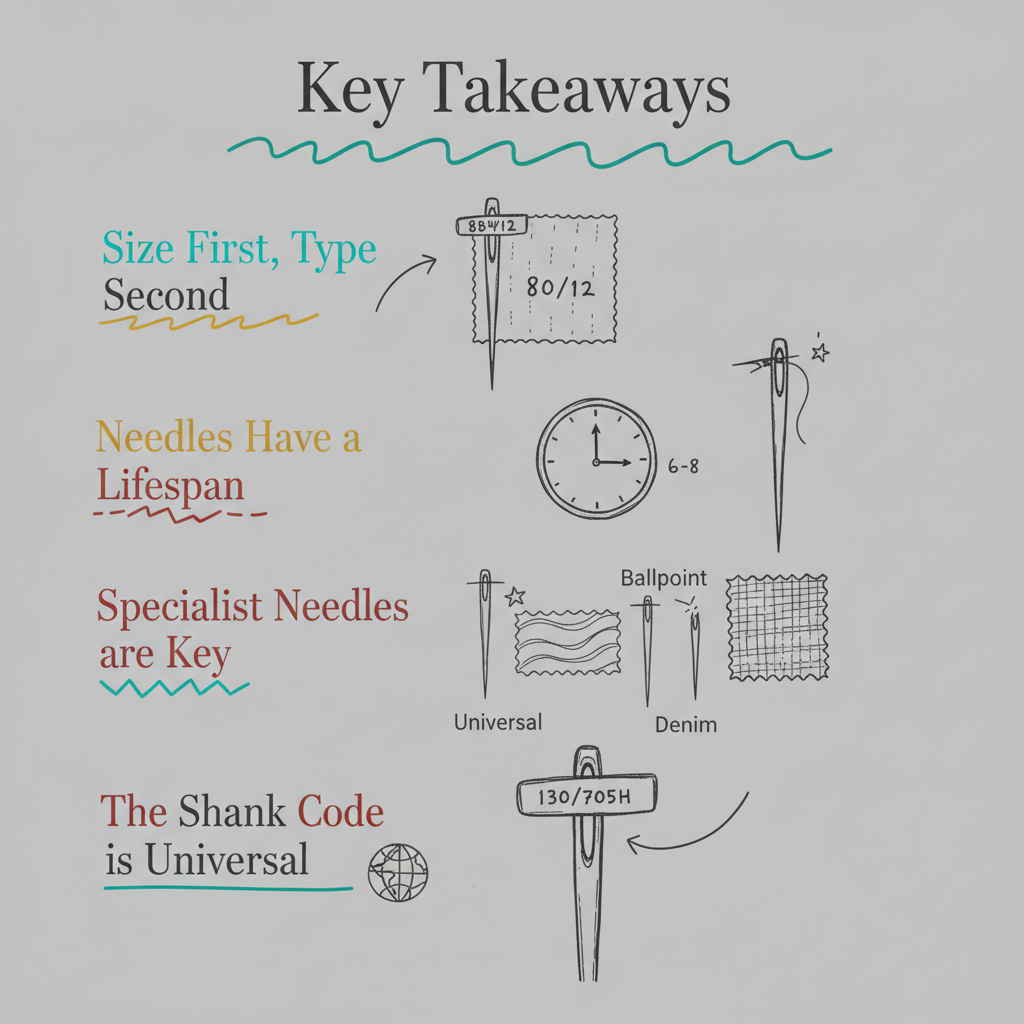
    Key Takeaways

    • Size First, Type Second: The numbers on your needle packet (like $80/12$) are essential. They indicate the diameter of the needle, which must match the weight of your fabric to prevent snags and damage.
    • Needles Have a Lifespan: A dull, burred, or bent needle is the leading cause of poor stitching quality. You should change your needle every 6 to 8 hours of active sewing, or with every major new project.
    • Specialist Needles are Key: While the Universal needle is a great starting point, using the correct specialty needle—such as a Ballpoint for knits or a Denim needle for canvas—is critical for achieving a professional finish.
    • The Shank Code is Universal: The 130/705H code found on machine needles tells you that the needle has a flat back, meaning it will fit correctly into virtually all modern domestic sewing machines.

    Unlocking Your Machine’s Potential

    When you first begin your creative journey, you focus on thread colour, fabric patterns, and the basic stitches. Yet, the true unsung hero of your sewing machine is the humble needle. Too often, a simple needle issue is mistaken for a complex machine problem. Learning what are the different types of sewing needles and how to use them is not just a detail; it’s a fundamental skill that will immediately elevate the quality of your finished projects.

    Think of your sewing needle as the key to a perfect stitch. It’s the only part of your machine that physically pierces the fabric, and if it’s the wrong size or shape, it will tear delicate fibres, skip stitches, or simply snap. Whether you are just getting started with the basics of sewing or have been creating for years, understanding this small component is crucial for frustration-free crafting.

    The Ultimate Needle Reference Guide (Sizing & Types Explained)

    Before we explore the different points and shafts designed for specific fabrics, we must first learn the universal language of the needle: its size. This is perhaps the most confusing area for students, but once you understand the simple logic behind the numbers, you will choose the right needle confidently every time.

    Decoding the Sizing System: What Does 80/12 Mean?

    Needle packets display a dual numbering system. This is a deliberate choice to cater to both European and American sizing conventions. If you see a needle marked what does 80/12 needle mean, you are looking at a medium-sized needle that is suitable for medium-weight woven fabrics like cotton or linen. The two numbers describe the exact same physical size.

    The European Number: Understanding 80/12 and 90/14

    The first number, $80$ (the European metric number), represents the diameter of the needle shaft in hundredths of a millimetre. Therefore, an $80$ needle is $0.80\text{mm}$ thick. Likewise, an ultra-fine $60$ needle is $0.60\text{mm}$ thick, and a heavy-duty $110$ needle is $1.10\text{mm}$ thick.

    The second number, $12$ (the American number), is based on an older imperial system. It’s simpler to remember the rule: the higher the number, the thicker the needle. For instance, a common medium-heavy needle size is what does 90/14 mean in sewing needles. A $90/14$ is slightly thicker than an $80/12$ and is ideal for slightly heavier fabrics or multiple layers. When you are learning how to operate your sewing machine, getting the right size is the fastest way to avoid damaging your projects.

    What Does 130/705H Mean? Decoding the Shank Code

    Beyond the size, you will also see an important code on the packet, such as what does 130/705H mean. This code is a universal identifier for the shank—the part of the needle that goes into your machine’s needle clamp. The code means:

    • 130/705: This is the standard designation for a domestic machine needle. It signifies that the needle has a flat side on the shank, ensuring it can only be inserted in one direction.
    • H: This suffix stands for Hohlkehle (German for scarf or groove), indicating that the needle has a groove down the front to protect the thread. This $\text{H}$ is often used for Universal needles. Other letters, such as $\text{E}$ for Embroidery or $\text{Q}$ for Quilting, indicate the specific needle type. To explore our other helpful articles on mastering your machine, visit our Sewing Blog.

    Core Needle Types: Your Essential Sewing Kit

    Once you master the sizing, the next step is understanding the type of needle point required for different fabrics. The right point prevents damage and ensures your stitches are perfect. You wouldn’t use a sharp kitchen knife to cut soft butter, and the same principle applies here: match the needle’s tip to the fabric’s structure.

    Universal Needles: The Workhorse of the Sewing Room

    The Universal needle is the most common needle you will encounter. If a pattern doesn’t specify a needle, it is usually safe to assume they mean a Universal. So, what are universal sewing machine needles used for? They are designed with a very slight, slightly rounded point, making them adaptable for use on most woven fabrics and some stable knits. They are a brilliant option for general practice and a wide variety of sewing tasks, such as creating basic garments or home accessories. Always have a few $80/12$ and $90/14$ Universal needles in your kit; they are the staple for your day-to-day sewing. They are a reliable entry point for anyone taking Guide to Beginner Seamstress Courses.

    Ballpoint and Stretch Needles: For Knits and Elastane

    Knitted fabrics, such as jersey, interlock, or any material with stretch, cannot be treated the same way as woven cloth. A sharp point will cut and break the fabric’s knitted loops, leading to skipped stitches or tiny holes that worsen over time. Instead, these materials require a needle with a rounded tip—a Ballpoint or Stretch needle. These needles gently push the fibres apart rather than piercing them. The Stretch needle has an even deeper scarf to prevent skipped stitches on high-stretch fabrics like Lycra or elastane. Remember this golden rule whenever you learn how to sew and alter clothes made from stretch materials.

    Denim and Jeans Needles: Punching Through Heavy Fabric

    When tackling heavy, densely woven fabrics—such as true denim, canvas, duck cloth, or upholstery material—you need a needle designed for power. This is where the Denim needle comes in. What does a denim needle look like? It has a very sharp, strong point and a robust shaft, often described as having a wedge shape near the tip. This structure allows it to penetrate thick, tightly woven fabrics without bending, which is critical when stitching seams that involve multiple layers. A common size for this type is $100/16$ or even $110/18$. Using a Universal needle on denim is a sure way to break it!

    Microtex and Sharp Needles: Precision for Fine Fabrics

    On the opposite end of the spectrum, fabrics like silk, microfibre, or highly delicate synthetics require exceptional precision. The Microtex (or Sharp) needle has an extra-fine, acute point that pierces the threads of the fabric accurately. This is the perfect needle for achieving incredibly straight, detailed top-stitching and for ensuring a neat seam on very fine materials where any small snag would be visible. If you are ever doing Custom Private Sewing Lessons London that involve couture techniques, you will undoubtedly use a Microtex needle.

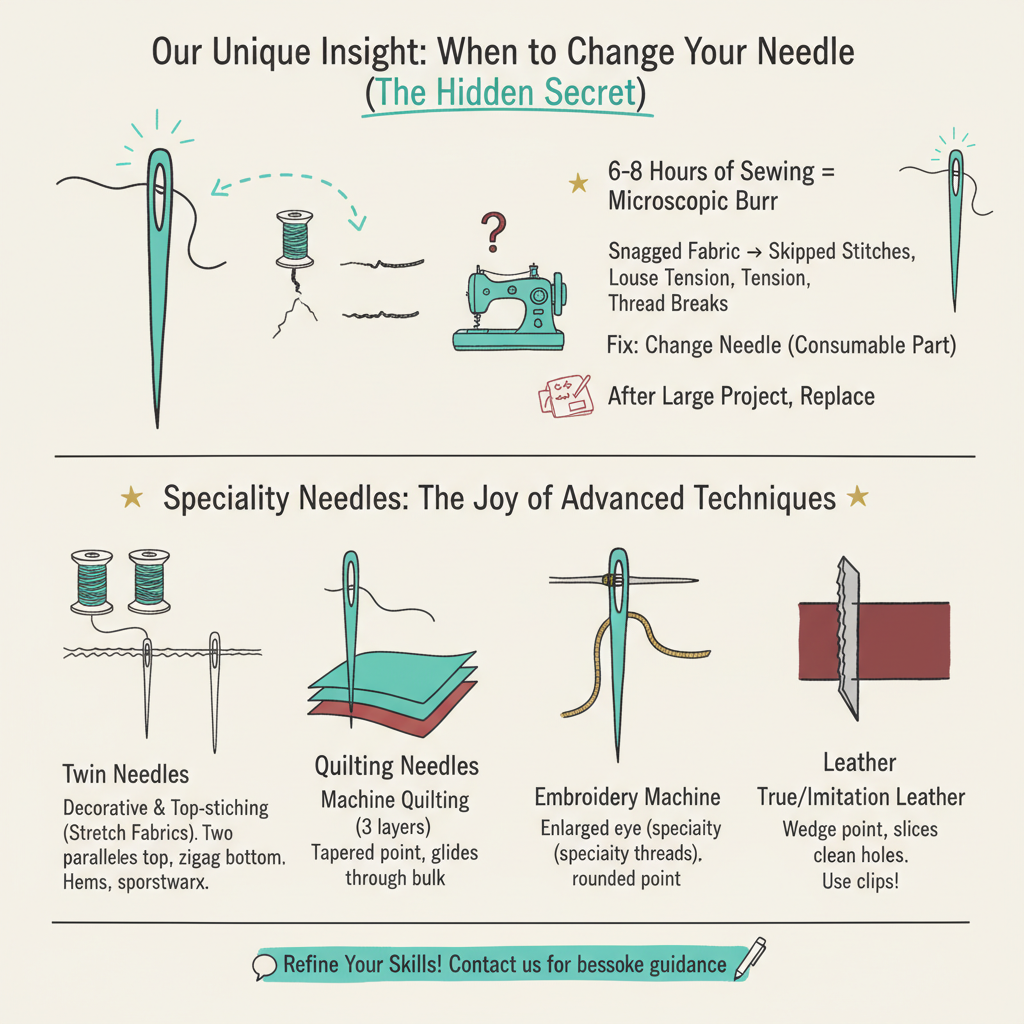
    Our Unique Insight: When to Change Your Needle (The Hidden Secret)

    This is a piece of advice many Intermediate London Sewing Courses for Adults often highlight: changing your needle frequently is the cheapest, easiest way to improve your sewing quality. A needle doesn’t need to break to be dull. After just six to eight hours of sewing, the tip of your needle can develop a microscopic burr, invisible to the naked eye, which causes it to snag the fabric. This leads to skipped stitches, loose tension, and minor thread breaks.

    If you find yourself constantly adjusting your tension dial or hearing a slight pop, pop, pop as the needle hits the fabric, the first step is always to change your needle. Treat it as a consumable part, like a spool of thread. If you finish a large project, replace the needle before starting the next. This simple habit will save you endless frustration and wasted fabric, keeping your focus on the joy of creating. If you’re interested in refining these habits further, consider Contact us for bespoke guidance.

    Speciality Needles: The Joy of Advanced Techniques

    Moving beyond the essential types, exploring speciality needles opens up a world of advanced possibilities for your projects. These needles are designed for unique applications, helping you achieve professional, intricate results that a Universal needle simply cannot manage. If you’re expanding your skills past the basics, these are the tools you’ll need.

    Twin Needles: What Are Twin Needles Used For?

    The Twin Needle is one of the most exciting additions to a sewing kit. A common question among beginners and experienced crafters alike is what are twin needles used for? The answer is primarily decorative and functional top-stitching, especially on stretch fabrics.

    A twin needle is a single shank with two needles set closely together. When you sew, it uses two spools of thread on top and one bobbin thread underneath. This arrangement creates two perfectly parallel lines of straight stitching on the top of the fabric, while the bobbin thread forms a desirable, zig-zag stitch between them on the underside.

    Twin needles are indispensable for hemming t-shirts, sportswear, and other stretch garments, giving them that professional, ready-to-wear finish. They eliminate the need for a dedicated coverstitch machine and are a simple way to add parallel decorative stitching to cuffs and pockets. Before you use one, you must learn how to thread your machine for two top threads; a quick look at your machine’s manual is usually all it takes to learn to How to Learn to use a Sewing Machine.

    Quilting and Embroidery Needles

    • Quilting Needles: These are specifically designed for machine quilting, where you are stitching through three layers: the top, batting, and backing fabric. They often feature a tapered, slightly rounded point (a type of ballpoint) that glides through the bulk without stressing the fabric layers. This design helps reduce skipped stitches and ensures consistent, beautiful stitching across a large quilt.
    • Embroidery Needles: If your machine has embroidery capabilities, these needles are essential. They have an enlarged eye and a slightly rounded point. The large eye accommodates specialty threads (like rayon or metallic threads) without shredding them as they pass through, and the rounded point protects the base fabric during the rapid, intense movement of machine embroidery.

    Leather Needles: The Wedge Point

    True leather and imitation leather require a different approach entirely. Unlike woven fabrics that are penetrated, leather needs to be cut. The Leather needle features a unique cutting point, shaped like a small wedge or chisel. As it descends, it slices a clean hole through the leather, which is crucial because a leather project is unforgiving—once a hole is made, it cannot be undone. Always use clips, not pins, and only a Leather needle when working with skins.

    Actionable Strategy: Three Steps to Identify Your Fabric’s Perfect Needle

    As your confident sewing tutor, I want to give you a simple, repeatable process for selecting the right needle for any new project. This method takes the guesswork out of the equation.

    1. Assess the Fabric Weight (Size):
      • Featherweight: Think silk, chiffon, tulle. Use a fine needle: $60/8$ or $65/9$.
      • Medium-Weight: Cotton, linen, rayon. Use a general-purpose needle: $70/10$ to $80/12$.
      • Heavy-Weight: Denim, canvas, upholstery. Use a robust needle: $90/14$ to $100/16$.
    2. Determine the Fabric Structure (Point Type):
      • Woven (no stretch): Universal or Microtex (for very fine, delicate wovens).
      • Knit (stretch): Ballpoint or Stretch.
      • Non-Fabric (leather, vinyl): Leather (wedge point).
    3. Perform a Test Swatch:
      • Never start on your final garment. Grab a small scrap of the main fabric and another scrap of the interfacing/lining you are using. Stitch a few rows.
      • Result Check: Are there any skipped stitches? Is the thread shredding? Do you hear a pop sound (indicating the needle is breaking fibres)? If the answer to any of these is yes, go back to Step 2 and try a different point type.

    Following this simple strategy ensures that you get the needle right before you commit to cutting and stitching your main fabric. It’s a technique taught in all our Sewing Classes London For Adults and one that will serve you well.

    Frequently Asked Questions (FAQ)

    Q: Why do my stitches keep skipping, even with a new needle?

    Skipped stitches are often a sign that the needle is not suitable for the fabric’s structure. If you are sewing a knit or stretchy material, you must be using a Ballpoint or Stretch needle, not a Universal one. If the needle tip cuts the fabric loops instead of separating them, the hook underneath cannot properly catch the loop of thread to form the stitch. Change the type of needle to a Ballpoint, and the problem should vanish immediately.

    Q: Can I use hand-sewing needles in my machine?

    Absolutely not. Hand-sewing needles and machine needles have completely different designs. A hand needle is uniform and pointed at both ends for manual threading and passing through fabric. A machine needle, however, has a flat shank, a specific eye position, and a groove that works with the machine’s mechanics to form a lockstitch. Using the wrong type of needle will damage your sewing machine. Always ensure the packet includes the $130/705$H code.

    Q: How can I tell which needle size is already in my machine?

    Since the size marking on the needle shank is tiny and difficult to read, the best way is to use a needle sizer tool, often included in higher-quality needle kits. If you don’t have one, carefully compare the current needle to a known new needle from a packet you have. If in doubt, the safest and most reliable approach is to remove the old needle and replace it with a brand new one of a size you know (like $80/12$), logging the date you changed it for future reference.

    Q: Do I need different needles for different thread types?

    Yes, sometimes. While a Universal needle works well with standard polyester and cotton threads, specialty threads—such as metallic, invisible, or heavy-duty topstitching threads—benefit greatly from a specialty needle. For example, a Metallic needle has an extra-large, smooth eye to prevent the thread from shredding. Similarly, a heavy-duty thread may require a needle with a larger eye and shaft, such as a $100/16$ or $110/18$, to accommodate the thickness.

    Conclusion

    Mastering the types and sizes of sewing needles is the single most effective way to improve your sewing output and reduce frustration. By understanding the simple code—matching needle thickness to fabric weight, and the needle’s point to the fabric structure—you eliminate the most common causes of skipped stitches, thread breakage, and damaged materials. You have the power to make your machine function perfectly simply by selecting the right tool for the job.

    We hope this comprehensive guide has demystified the selection process and empowered you to choose your next needle with confidence. The difference between a simple stitch and a truly professional finish often comes down to this tiny, essential component. Continue your journey to perfect sewing by exploring our sewing blog for more expert tips and course details. If you’re ready to put theory into practice, why not sign up for one of our intensive Sewing Classes London For Beginners and start creating today?

    About the Author: Grace, Founder of London Sewing Courses

    Grace is the heart and hands behind London Sewing Courses. A passionate and experienced sewing instructor, she founded the studio with a unique mission: to create a calm, friendly space for adults to learn and connect, while using the profits to fund free sewing classes for local children in need. Her personal expertise and commitment to community building are at the core of every class and every stitch.

    Sources

    Types of Sewing Machine Needles

    (https://www.whaleys-bradford.ltd.uk/news-guides/types-of-sewing-machine-needles/)

    How to Choose the Right Sewing Machine Needle (https://singerco.com.au/howto/how-to-choose-the-right-sewing-machine-needle/)

    Needle Guide

    (https://www.schmetzneedles.com/pages/needle-guide)

  • What is a Serger? Your Complete Guide to the Overlocker Machine

    What is a Serger? Your Complete Guide to the Overlocker Machine

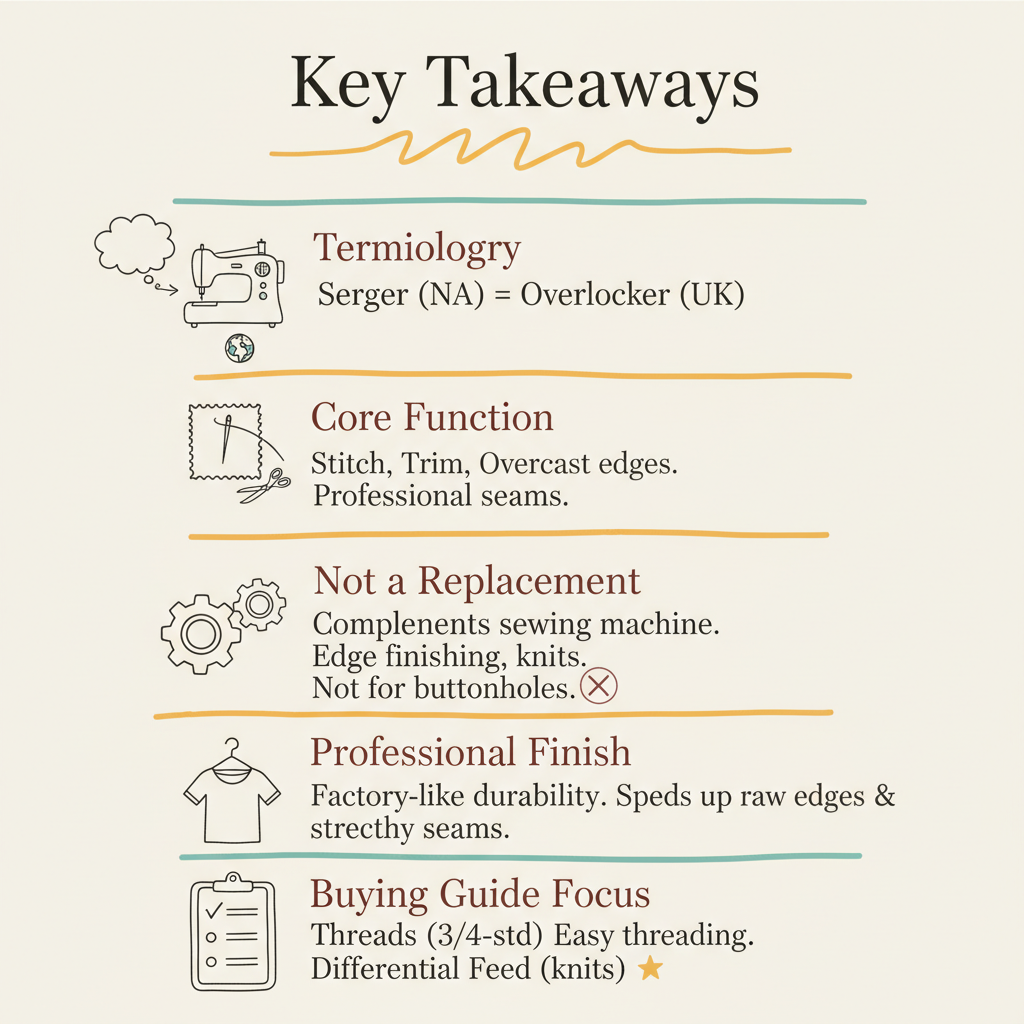
    Key Takeaways

    • Terminology: A serger is simply the North American term for an overlocker machine. In the UK, we almost exclusively use the term overlocker.
    • Core Function: The primary role of a serger is to simultaneously stitch, trim, and overcast the edge of fabric, creating professional, non-fraying seams quickly and efficiently.
    • Not a Replacement: An overlocker does not replace a standard sewing machine; it complements it. It excels at finishing edges and constructing knit garments but cannot perform tasks like buttonholes or topstitching.
    • Professional Finish: Using an overlocker is the fastest way to achieve the durable, factory-like finish seen on high-street clothing, especially for securing raw edges and creating stretchy seams.
    • Buying Guide Focus: When deciding what serger should I buy?, focus on the number of threads (3/4-thread is standard), ease of threading, and the presence of differential feed for working with knit and stretchy fabrics.

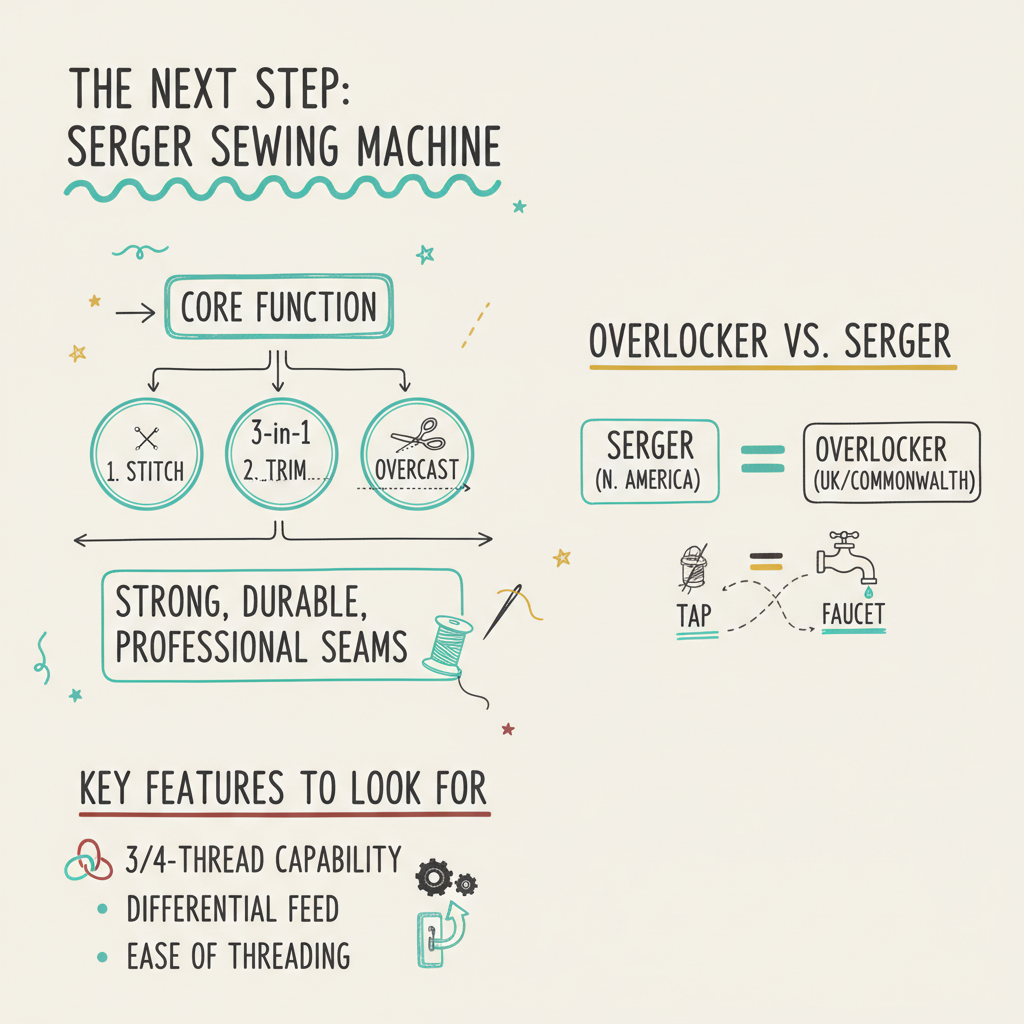
    The Next Step: what is a serger sewing machine?

    You’ve mastered your standard sewing machine, and now you’ve encountered a mysterious new tool: the serger. You might hear it called a serger, an overlocker, or even a serger sewing machine, but rest assured, they all refer to the same brilliant piece of kit. It’s the machine that transforms a home-sewn garment from ‘homemade’ to ‘professionally finished,’ and it’s essential for anyone serious about their craft.

    Overlocker vs. Serger: Clearing Up the Confusion

    Let’s tackle the most common point of confusion first. What is a serger? In short, it’s the name used predominantly in North America. Here in the UK and in most Commonwealth countries, we call it an overlocker. They are exactly the same machine, performing the same function.

    Think of it like calling a tap a faucet—different words for the same thing. Since our classes and articles use British English, we will primarily refer to it as an overlocker from here on, but know that any machine labelled a serger is its twin.

    The Core Function: what does an overlocker do?

    The overlocker’s function is unique and distinct from a regular sewing machine. A standard machine uses two threads (top and bobbin) to create one line of stitching. An overlocker, or serger, uses three, four, or even five threads that interlock around the raw edge of the fabric.

    Critically, the machine includes a built-in blade that trims the fabric edge just before the threads wrap around it. This process achieves three things simultaneously:

    1. Stitch: It joins two or more pieces of fabric together.
    2. Trim: It neatly cuts the raw edge of the fabric.
    3. Overcast: It wraps the thread securely around that newly cut edge, preventing fraying forever.

    This speed and efficiency are the answers to the question, what does an overlocker do? It creates strong, durable, and highly professional-looking seams in a single, fluid pass.

    Our Unique Insight: The Critical Difference a Serger Makes

    When we teach our students about garment construction, we always highlight that the durability and longevity of a piece of clothing often come down to the quality of the seam finish. This is the critical difference a serger makes.

    Imagine sewing a T-shirt. You sew the side seam on your regular machine. The seam allowances inside are left raw. Over time, in the washing machine and through wear, those raw cotton or knit edges will begin to shed fibres and fray, weakening the seam.

    Mastering the Machine: what do overlockers do?

    Understanding what do overlockers do is about appreciating their versatility beyond a simple seam finish. While the 4-thread overlock stitch is its most common function, these machines are powerhouses with several specialty stitches that can elevate your projects.

    Beyond the Seam: Decorative and Specialty Stitches

    The overlocker’s true magic lies in its ability to create specialist finishes that are impossible on a regular machine:

    • 3-Thread Overlock: Ideal for finishing the edge of non-fraying woven fabrics, such as fine wool or gabardine, or for decorative edges.
    • Rolled Hem: This stitch is a game-changer for finishing lightweight or delicate fabrics like chiffon and silk. The overlocker rolls the fabric edge tightly into itself and encases it with dense stitching, producing the neat, fine edge you see on scarves and professional eveningwear.
    • Flatlock Stitch: A strong, flat seam often used for sportswear or creating decorative texture. This stitch is designed to be comfortable against the skin, making it perfect for activewear construction.

    When to Use an Overlocker for a Professional Finish

    You should reach for your overlocker whenever you are:

    1. Working with Knits: Constructing tops, dresses, or any garment made from a stretch fabric. The overlock stitch has the necessary ‘give’.
    2. Finishing Raw Edges: Sealing the seams inside a jacket, a pair of trousers, or any woven item to ensure they survive regular washing.
    3. Doing Fine Detail Work: Creating delicate edges on ruffles, napkins, or shirt collars with the rolled hem feature.
    4. Batch Sewing: When you need speed and efficiency, the overlocker cuts down on the time spent finishing seams.

    The Purchase Decision: what serger should i buy?

    Now that you know the answer to what is a serger and understand the value of an overlocker, the next logical question is: what serger should i buy? The market can seem overwhelming, filled with three-thread, four-thread, and even five-thread models. As your patient tutor, I want to guide you through the features that genuinely matter, ensuring your investment enhances, rather than complicates, your creative journey.

    Essential Features: What to Look for in a Beginner Overlocker

    Choosing your first overlocker isn’t about finding the most expensive model; it’s about finding a reliable workhorse with the right foundations. When shopping, focus on these three critical features:

    1. 3/4-Thread Capability: For almost all home sewing, a machine that can perform both a 3-thread and 4-thread stitch is perfect. The 4-thread stitch is your go-to for strong, construction seams on knits, and the 3-thread is ideal for finishing woven fabric edges and performing rolled hems. Anything more complex, like a 5-thread coverstitch, is usually only necessary for professional tailoring or commercial volumes.
    2. Differential Feed: As we mentioned before, this is non-negotiable. If you plan to sew stretchy fabrics—the very thing an overlocker excels at—you need the differential feed to prevent wavy, stretched-out seams or puckering. Ensure the machine has clearly labelled, easily adjustable dials for this function.
    3. Ease of Threading: Overlockers have a reputation for being tricky to thread, but modern machines have vastly improved this process. Look for machines with colour-coded guides inside the looper covers. Better yet, some premium models now offer air-threading, where you simply push the thread into a port and the machine blasts it into place. If you are learning Sewing Classes North London, we often recommend a model with good threading support to reduce frustration.

    Addressing the Buying Anxiety: what is the best serger to buy?

    The question what is the best serger to buy? is personal, but we can offer some clear direction. The “best” machine is the one you will actually use. For beginners and those moving to Intermediate London Sewing Courses for Adults, we recommend models from established, reliable brands (often Janome, Brother, or Juki).

    Instead of focusing on a specific model number, look for the features above, and read reviews that focus specifically on:

    • Noise Level: Some cheaper overlockers are extremely loud, which can make long sewing sessions unpleasant.
    • Stitch Quality: Ensure the machine produces even, balanced stitches across a range of fabric thicknesses.
    • Customer Support: A good brand will have videos and manuals readily available to help you master re-threading and tension adjustments.

    Our expert advice is to invest in the best quality machine you can comfortably afford, focusing on the core 3/4-thread capability and a good differential feed.

    Actionable Strategy: Troubleshooting Common Serger Issues

    While overlockers are fantastic, they can occasionally present challenges. Knowing how to quickly troubleshoot common issues will keep your machine running smoothly:

    1. Skipped Stitches: This is almost always a sign that your needles are blunt or incorrectly inserted. Solution: Replace the needles (use high-quality serger needles) and ensure the flat side of the needle shank is facing the correct direction, usually toward the back of the machine.
    2. Wavy Seams (Puckering or Stretching): Solution: Adjust the differential feed. If the fabric is stretching and getting wavy, increase the differential feed setting (e.g., from 1 to 1.5). If the fabric is bunching up or puckering, decrease the setting (e.g., from 1 to 0.7).
    3. Tension Tangles: If your stitches are messy or loops are forming on the underside, your tension is wrong. Solution: Reset all four dials back to their factory standard setting (usually marked around 4 or 5). Adjust only one dial at a time, usually the needle tension, to see what impact it has before adjusting the loopers.

    Frequently Asked Questions (FAQ)

    How many threads does a serger need?

    A serger typically needs either three or four threads for general home sewing. A 3-thread stitch is used for finishing the edges of woven fabrics and creating rolled hems. A 4-thread stitch is the most common for constructing strong, professional, and stretchy seams on knits. While 2-thread machines exist, and 5-thread machines are available, the 3/4-thread model offers the best balance of versatility and ease of use for the home sewist.

    Is a serger hard to re-thread?

    The process of re-threading a serger can be daunting at first glance due to the multiple threads. However, if you follow the colour-coded paths precisely and use a pair of long-nosed tweezers, it becomes quite manageable. Many experienced sewists use the “tie-on” method: cutting the old threads, tying the new thread ends to the old ones, and simply pulling them through the machine. This bypasses the need to thread the loopers manually altogether.

    Can I use a serger without a regular sewing machine?

    You can certainly use an overlocker machine independently, but you cannot replace a regular sewing machine with it. The overlocker is fantastic for creating strong seams and finishing edges, but it cannot perform essential tasks such as topstitching, creating buttonholes, sewing zips, or detailed decorative stitches. The two machines work in tandem, with the overlocker focusing on bulk construction and seam finishing, and the regular machine handling closures and flat stitching.


    Conclusion

    The overlocker, or serger, is the indispensable companion to your standard sewing machine. It is the tool that closes the gap between the garments you sew at home and the clothes you buy in the shops. By understanding what is a serger and embracing its unique ability to stitch, trim, and overcast simultaneously, you unlock a new level of speed, durability, and professionalism in your projects.


    About the Author: Grace, Founder of London Sewing Courses

    Grace is the heart and hands behind London Sewing Courses. A passionate and experienced sewing instructor, she founded the studio with a unique mission: to create a calm, friendly space for adults to learn and connect, while using the profits to fund free sewing classes for local children in need. Her personal expertise and commitment to community building are at the core of every class and every stitch.


    Sources

  • The Simple Secret: How to Thread a Needle

    The Simple Secret: How to Thread a Needle

    Key Takeaways

    • Prep is Everything: Trimming the thread end cleanly at an angle and wetting or stiffening the tip are the most effective ways to prevent fraying and make threading easier.
    • Needle Still, Thread Moves: For the traditional hand method, holding the needle still and pushing the thread eye-first through is more successful than trying to guide a tiny, floppy piece of thread.
    • Know Your Tools: Basic wire loop threaders are perfect for small hand-sewing needles, while automatic threaders are a fantastic aid on most modern sewing machines.
    • Specialist Help: Self-threading or ‘calyx eye’ needles are a simple solution for those with dexterity challenges or poor eyesight, allowing you to slip the thread through a notch at the top.
    • The Next Step: Once you master how to thread a needle, the next crucial skill is securing a perfect knot to ensure your stitches hold firm.

    The Foundation: Why Learning how to thread a needle is Your First Step

    Welcome, dear student. If you’ve ever felt a pang of frustration trying to coax a delicate strand of thread through the minuscule eye of a needle, know that you are in good company. This tiny, seemingly simple step is where every great sewing journey truly begins. Mastering how to thread a needle isn’t just about getting the job done; it’s about building the patience, precision, and confidence that underpin all skilled tailoring. Think of it as your foundation—the quiet moment of preparation before the beautiful, creative work begins.

    The Traditional Method: How to Thread a Sewing Needle by Hand

    To truly become a confident seamstress or tailor, you must first master the classic method: how do you thread a sewing needle using only your hands. This skill is vital for mending, hand finishing, and all the essential details that give your creations a professional polish. The key is to prepare both the thread and the needle properly.

    how do you thread a needle

    Preparing the Thread and Needle

    Before you even attempt to put thread in a needle, you need to set yourself up for success. This preparation process is the secret many overlook. First, cut a manageable length of thread—around 45 to 60 centimetres is ideal. A longer piece will twist, tangle, and fray much faster, leading to headaches later.

    Essential Hand-Threading Techniques

    Once your thread is perfectly prepped, it is time to tackle the actual threading. Forget trying to poke the thread through while holding the needle in mid-air—that is a common mistake that leads to frustration. Instead, follow this simple, two-step process:

    1. Hold the Needle Still: Place the needle horizontally on a flat, light surface, or simply pinch the shaft firmly between the thumb and forefinger of your non-dominant hand. Hold it close to the eye. The needle must not move.

    Our Unique Insight: Overcoming the Fraying Frustration

    The most common point of failure when you try to put thread in a needle is fraying. You cut the thread, you aim for the eye, and the end seems to instantly bloom into a cotton fluffball, making the task impossible. This is where a change of technique, rather than sheer luck, saves the day.

    We teach our students a unique tip: hold the thread end right next to the needle’s eye, then press the thread against the needle with your thumb, effectively folding the thread over the needle shaft. When you pull the needle away, you leave behind a sharp, tiny loop of thread that is already oriented in the direction you need. Then, you simply pinch the loop firmly between your fingers and push it straight through. This trick allows you to present a more substantial and less-frayed point to the needle’s eye.

    Effortless Threading: How to Use a Threader to Thread a Needle

    While mastering the hand-threading technique is a mark of a skilled seamstress, there is absolutely no shame in turning to modern aids! Sometimes the needle eye is simply too small, the thread too thick, or the light is just not quite right. Using a needle threader is a practical, clever way to conserve your eyesight and your patience. If you’ve ever wondered how do you use a threader to thread a needle, you’ll be pleased to know it’s incredibly simple.

    The Simple Wire Threader

    The most common tool is the inexpensive, diamond-shaped piece of metal or plastic with a tiny, delicate wire loop attached. This is often found in basic sewing kits and is perfect for hand-sewing needles.

    1. Insert the Wire: Push the fine wire loop through the eye of the needle, going from the side you want the thread to come out of. The wire is much thinner and stiffer than the thread, making this step easy.
    2. Thread the Loop: Once the wire is through, pass your main sewing thread through the large, accommodating opening of the wire loop.
    3. Pull Back: Gently hold the needle in one hand and pull the threader back out of the needle eye. As the wire comes through, it drags a loop of your thread cleanly and seamlessly with it.

    Mastering Automatic Machine Threaders

    Moving from hand-sewing to a machine brings its own set of challenges, especially for beginners learning how to thread a needle on a new model. Most modern sewing machines come equipped with a built-in automatic needle threader, often a tiny lever or mechanism next to the needle bar.

    Specialist Needles: how do you thread a self threading needle

    For many years, some students assumed that if you couldn’t easily thread a traditional needle, your sewing days were limited. Thankfully, technology has given us a superb alternative: the self-threading needle. These needles, sometimes called calyx-eye or easy-thread needles, are brilliant if you struggle with fine motor skills or have visual impairment.

    So, how do you thread a self threading needle? It couldn’t be simpler:

    1. Find the Groove: Look closely at the top of the needle eye. You will see a small ‘V’ shaped groove or slot that opens into the eye.
    2. Slip the Thread: Take your prepared thread and press it down and across this groove. You don’t push it through the traditional way; you just press it into the channel.
    3. The Click: With gentle pressure, the thread will snap or ‘click’ into the needle eye, held securely by the pressure of the metal.

    The Next Step: how do you sew with a needle and thread

    Once your thread is secured in the needle, you’re ready for the exhilarating part: creating! Knowing how do you sew with a needle and thread shifts the focus from preparation to technique. Every stitch you take relies on that strong connection between the needle and the thread, so it’s essential to secure it first.

    Securing the Thread: The Perfect Knot

    A perfect knot is a stitch’s anchor; without it, all your beautiful work will simply pull out. We recommend the simple, yet reliable, “wrap and roll” knot method:

    1. The Wrap: Hold the needle between your thumb and forefinger. Lay the end of the thread against the needle shaft, and use your other hand to wrap the thread end around the needle two or three times.
    2. The Roll and Pull: Pinch the wrapped thread tightly against the needle and slide your thumb and forefinger down the needle, rolling the wraps off the end of the needle.
    3. The Tighten: Pull the thread taut as the loop slides off the tip. The wraps will gather into a neat, firm knot at the very end of the thread. Trim any long tail close to the knot.

    Getting Started on Your Project

    Actionable Strategy: Three Tricks to Try Today

    Here are three simple, low-effort tricks you can implement right now to make your threading experience better and faster:

    1. The Hairspray Hack: If you don’t have thread wax, a tiny spritz of cheap hairspray on the last centimetre of the thread will stiffen it instantly. Let it dry for two seconds, and you’ll have a sharp, durable point.
    2. Use Contrast: If you’re using dark thread, place a piece of white paper or a light-coloured mat underneath your needle. If you’re using light thread, use a dark surface. The increased contrast makes the needle eye far easier to see.
    3. Invest in a Good Thimble: A thimble might seem unrelated, but it’s part of the process. If your fingers are struggling to push the needle through thick fabric, they’ll quickly tire, and your precision for threading will suffer. A thimble helps you maintain control and accuracy throughout your sewing session.

    Frequently Asked Questions (FAQ)

    How long should I cut my thread?

    For hand-sewing, aim for a length between 45 to 60 centimetres, or approximately the length from your hand to your elbow. A shorter length is much less likely to twist, tangle, or knot prematurely while you are stitching, which saves time and prevents frustrating snarls. If you are working on a very long seam, it is always better to re-thread the needle a few times than struggle with an unwieldy, overly long piece of thread.

    What should I do if my thread keeps falling out?

    The most likely culprit is that you have not pulled enough thread through the needle eye after threading it. When you thread the needle, pull at least 10 to 15 centimetres through to the other side. This longer tail prevents the thread from slipping back out as you start your first few stitches. Alternatively, try a small overhand knot around the eye of the needle shaft itself to temporarily secure the thread for extra thick or slippery fabrics.

    Can I thread a needle with two strands?

    Absolutely, and it is common practice, particularly for buttons, upholstery, or any stitching that requires extra strength and durability. To do this, simply thread your needle with a single strand, but instead of knotting the tail, bring both ends of the thread together and knot them. This creates two working strands, resulting in a much stronger line of stitching. Just ensure the needle eye is large enough to accommodate the doubled thickness of your thread without difficulty.

    Conclusion

    The simple act of learning how to thread a needle is the gatekeeper skill for all other forms of sewing, mending, and creative work. Whether you are using the traditional hand-sewing technique, employing the clever mechanism of a threader, or utilising the convenience of a self-threading needle, the principles of preparation and patience remain your greatest assets.

    We hope this detailed guide has given you the confidence to conquer this essential first step. Remember, every master tailor, seamstress, and crafter started exactly where you are today. With practice, threading will become a quick, automatic action that allows you to move swiftly onto the satisfying, rewarding work of stitching itself.

    About the Author: Grace, Founder of London Sewing Courses

    Grace is the heart and hands behind London Sewing Courses. A passionate and experienced sewing instructor, she founded the studio with a unique mission: to create a calm, friendly space for adults to learn and connect, while using the profits to fund free sewing classes for local children in need. Her personal expertise and commitment to community building are at the core of every class and every stitch.

    Sources

  • What Does a Walking Foot do on a Sewing Machine?

    What Does a Walking Foot do on a Sewing Machine?

    Key Takeaways

    • The Function: A walking foot is an essential presser foot that works with your machine’s feed dogs to feed fabric from both the top and bottom simultaneously.
    • The Result: This dual-feed action completely eliminates fabric shifting, bunching, puckering, and misalignments when stitching.
    • The Use: It is critical for successfully sewing challenging materials like slippery silks, thick fleece, stretchy knitwear, and multiple layers, such as those found in quilting.
    • The Look: A walking foot is easily recognisable by its larger, often mechanical frame and a fork-like arm that sits over the needle screw.
    • The Alternative: While the walking foot solves one major problem, specialty feet like the zipper foot solve others by allowing you to sew right up to a raised edge.

    Guide to Perfect Sewing

    Welcome to the wonderful world of presser feet! As a sewing tutor, I often see students struggling with fabric that just won’t behave—it stretches, it puckers, or the layers shift away from each other. If you’ve ever found yourself asking what does a walking foot do on a sewing machine, you’re about to discover the solution to these common frustrations. This accessory isn’t just a nice-to-have; it’s an absolute game-changer for mastering tricky fabrics and complex projects. It represents one of the most significant upgrades you can make to your machine’s capabilities.

    The Simple Answer: Understanding the Walking Foot’s Magic

    In the simplest terms, what does a sewing machine walking foot do? It makes your machine feed the top layer of fabric at exactly the same rate as the bottom layer.

    Normally, your sewing machine relies on small, jagged metal teeth, called feed dogs, which grab the bottom layer of fabric and pull it under the needle. The presser foot holds the top layer down. However, on slippery or very thick materials, this one-sided action is insufficient. The bottom layer moves perfectly, but the top layer drags slightly, resulting in an uneven seam, or “puckering,” especially near the end of the seam line.

    The walking foot acts as a secondary set of feed dogs working from above. It has its own mechanism that literally “walks” the top fabric layer forward in perfect sync with the feed dogs below. This means the two layers meet the needle at precisely the same moment, ensuring an impeccable, professional-quality stitch every time.

    what does a walking foot do on a sewing machine

    What Do You Use a Walking Foot For? Taming Tricky Fabrics

    Understanding what do you use a walking foot for opens up a whole new range of projects you can tackle with confidence. It is designed to solve any problem where uneven feeding or shifting layers are a concern.

    How the Dual Feed System Works: A Closer Look

    When you attach the walking foot, you’ll notice a small, C-shaped arm that sits right over the screw that holds the needle bar. This arm is the key. As the needle bar moves up and down during stitching, it activates the walking foot’s internal mechanism, causing the foot’s sole to lift and move the fabric forward. This continuous, rhythmic movement—the “walk”—ensures an even journey for both fabric layers.

    If you are learning to use a sewing machine, getting comfortable with the machine involves understanding how each foot interacts with your materials, and the walking foot is often the first essential accessory we introduce to students.

    Taming Multiple Layers: Quilting and Binding

    Perhaps the most famous application for the walking foot is in quilting. A standard quilt sandwich consists of three layers: the top fabric, the batting (wadding), and the backing fabric. Without a walking foot, stitching through this thickness is almost guaranteed to result in a wrinkled or bunched backing layer.

    The walking foot keeps those thick, heavy layers aligned perfectly, allowing you to quilt smoothly and accurately, whether you’re stitching in the ditch or using decorative lines. For those taking your skills further, this foot is indispensable for garment construction that involves bulk, such as installing linings or working with heavy coat fabrics.

    Working with Slippery and Stretchy Fabrics

    Beyond bulk, the walking foot is a hero for materials that slip and slide, or stretch out of shape. Think of working with luxurious but tricky fabrics like velvet, organza, or silk charmeuse—the walking foot ensures the top layer doesn’t glide away from the bottom.

    Likewise, when sewing elastic knit fabrics, such as jersey or spandex, the walking foot prevents the machine from stretching the fabric as it feeds, eliminating those frustrating wavy or lettuce-leaf edges. To truly master understanding how to sew and alter clothes, you must first master the right tools for the job.

    what does a walking foot do on a sewing machine

    Our Unique Insight: What a Sewing Machine Walking Foot Does for Garment Construction

    The utility of a walking foot, or what does a walking foot do on sewing machine, extends far beyond quilting. For those of you on a dedicated seamstress courses journey, the walking foot is a silent partner in achieving professional finishes on tailored garments.

    Consider projects that require matching patterns, like checks or stripes. Even the slightest shift between the pieces will ruin the entire look. By locking the layers in place, the walking foot allows you to precisely align your prints, ensuring seamless transitions across collars, cuffs, and pockets. It’s an invaluable tool for ensuring that meticulous alignment you see in high-end ready-to-wear clothing. For those seeking private sewing lessons London tailored just for you, mastering pattern matching with this foot is often a core lesson.

    sewing machine zipper foot guide

    What Does a Zipper Foot Do and When to Use It?

    While the walking foot solves the problem of fabric shifting, it’s only one of many specialist feet that belong in your toolkit. To truly advance your skills, you need to understand what do different sewing feet do, starting with the second most common specialist foot: the zipper foot.

    Unlike the all-purpose standard foot, the zipper foot is designed with a narrow profile that allows you to stitch right next to a raised edge, whether that’s the teeth of a zipper, the cording of piping, or a bead-encrusted trim.

    The key feature of a zipper foot is its adjustability; you can snap it on so that the needle passes to the left or the right of the foot itself. This adjustability means you can stitch close to the zipper teeth without accidentally sewing over them, which would break your needle. It is absolutely essential for achieving the neat, professional finish seen in high-quality garments.

    The Essential Role of the Standard Foot

    It is important not to forget your trusty standard foot. This is the all-rounder, the one you use for basic straight stitching and zigzag seams on medium-weight, stable woven fabrics. It provides a balanced hold that works well with the feed dogs for everyday sewing.

    However, as you progress, you’ll discover that the standard foot struggles with the very challenges the walking foot is designed to overcome. Recognising when to switch from your basic tool to a specialised one is a fundamental skill taught in all quality sewing classes London for adults. Knowing when a basic tool is sufficient and when you need a specialist one is a key takeaway from our intermediate London sewing courses for adults.

    Actionable Strategy: A Quick-Guide to What Do Different Sewing Feet Do

    Mastering your machine is not just about threading the needle; it’s about choosing the correct accessory for the task at hand. Here is a quick, actionable guide to help you decide which foot to use today.

    Mastering Presser Feet: Walking, Zipper, and Beyond

    Foot TypePrimary PurposeWhen to Use ItLook and Key Feature
    Walking FootEliminates shifting and puckering.Quilting, working with knits, velvet, or vinyl.A large, mechanical foot with an active upper feed system.
    Zipper FootSewing close to a raised edge.Installing zippers, adding piping or cording.A narrow, often asymmetrical foot that attaches to the left or right of the needle.
    Standard FootGeneral straight and zigzag stitching.Seaming stable woven fabrics (e.g., cotton, linen).The machine’s default foot, usually wide and balanced.
    Buttonhole FootCreating automated, consistent buttonholes.Making shirts, blouses, or jacket fronts.Often has a frame to measure the button size automatically.
    Free-Motion/Darning FootAllowing fabric to be moved in any direction.Darning holes or free-motion quilting.A small, round or oval foot that “hovers” over the fabric.

    Learning these distinctions is a key step for those who are learning to use a sewing machine. When you move beyond the basics, you begin to appreciate the precision each foot offers, which is especially helpful in custom private sewing lessons London.

    When to Change Your Foot: A Fabric-by-Fabric Guide

    If you’re unsure if a foot is needed, simply look at your fabric. If it’s slippery, very thick (more than two layers of denim), stretchy, or if you are deliberately stitching near a bulky edge (like a cord), swap out your standard foot immediately for a specialist.

    The walking foot (or twin-feed foot, as it’s sometimes called) is arguably the most valuable purchase you can make after the machine itself because of how many challenging materials it instantly renders manageable. It’s a game-changer for avoiding the frustration of fabric bunching up at the end of a seam.

    Frequently Asked Questions (FAQ)

    What does a walking foot for sewing look like?

    A walking foot is easily identifiable because it looks more complicated and mechanical than your standard presser foot. It is generally larger and bulkier, featuring its own set of feed dogs on the underside of the foot itself. The most defining visual feature is a fork-like arm or lever at the top of the foot. This arm must sit over the needle clamp screw, allowing the needle movement to drive the foot’s unique ‘walking’ action.

    Is a walking foot only for quilting?

    No, while the walking foot is highly prized by quilters for managing the three layers of a quilt sandwich, its use extends far beyond that. It is the best tool for any material where the top layer might drag or shift unevenly compared to the bottom. This includes sewing highly stretchy knits like jersey, slippery fabrics such as silk or sheer organza, and any project that involves matching complex patterns like plaids or stripes.

    Can I use a walking foot with my regular sewing machine?

    In most cases, yes. Walking feet are an accessory and are generally compatible with most low-shank or high-shank domestic sewing machines, though you may need to purchase one specific to your machine’s brand (e.g., Brother, Janome, or Singer) or a universal walking foot that matches your machine’s shank size. Always ensure the foot’s fork-like arm can properly engage with the needle screw for the mechanism to work effectively.

    Conclusion

    The journey through the world of presser feet might seem complex at first, but with a patient and encouraging approach, each foot becomes a familiar friend. When it comes to achieving flawless results on challenging materials, the answer to what does a walking foot do on a sewing machine becomes perfectly clear: it’s your indispensable ally against puckering, shifting, and stretching.

    By providing an even, dual-feed system, the walking foot ensures that whether you are tackling thick quilted layers or delicate silk organza, your seams will be impeccably neat and perfectly aligned. The difference between struggling with a slippery fabric and gliding smoothly through a seam often comes down to this simple, yet ingenious, piece of equipment. Remember that tools like the zipper foot and the walking foot are designed not to complicate your life, but to empower you to handle any project with elegance and confidence.

    If you are a beginner sewist just discovering the magic of these tools, or an advanced student looking to refine your finishing techniques, the path to expert sewing is always smoother with the right knowledge and the right accessories.

    Ready to put this knowledge into practice? Why not take the next step in your creative journey? We offer friendly, tailored Sewing Classes North London for all levels, from those just learning how to sew to those mastering advanced garment construction. Come and join our community, where we guide you through every presser foot, seam, and stitch. You can also dive deeper into specialised topics by visiting our informative Sewing Blog for more expert advice and inspiration.

    About the Author: Grace, Founder of London Sewing Courses

    Grace is the heart and hands behind London Sewing Courses. A passionate and experienced sewing instructor, she founded the studio with a unique mission: to create a calm, friendly space for adults to learn and connect, while using the profits to fund free sewing classes for local children in need. Her personal expertise and commitment to community building are at the core of every class and every stitch.

    Sources

    The following resources were consulted to provide you with the most up-to-date and authoritative information:

    The Sewing Directory (Guide to the Walking Foot) https://www.thesewingdirectory.co.uk/walking-foot-guide/

    Brother USA (Mass Sewing Foot Guide)

    https://www.brother-usa.com/-/media/files/had/masssewingfoot_final_links.pdf

    YouTube (Video on the Walking Foot in Action) https://www.youtube.com/watch?v=10DBLRNFOMc