Tag: Baby Lock

  • What is a Quarter Inch Sewing Machine Foot and Other Essential Attachments

    What is a Quarter Inch Sewing Machine Foot and Other Essential Attachments

    Key Takeaways

    • Precision is Paramount: Specialty feet like the quarter inch foot are essential for accurate seam allowances in quilting and garment construction.
    • Functional Variety: From what is a zipper foot used for to the complexities of a shirring foot, each attachment serves a unique structural purpose.
    • Professional Finishes: Using tools like an invisible zipper foot or overcast presser foot elevates home-made projects to retail quality.
    • Creative Expansion: Understanding what is a wing needle for sewing machines allows for decorative heirloom techniques like entredeux.

    The world of sewing often feels like a beautiful, intricate puzzle. When you first sit down at your machine, the array of small metal attachments can seem a little daunting. However, these tools are your best friends in the studio. They transform your machine from a simple stitching tool into a versatile instrument capable of high-end tailoring and delicate craft. Whether you are attending sewing classes North London or stitching away at home, knowing which foot to click into place is the first step toward mastery.

    Perhaps you have looked at your accessory box and wondered, “what is a quarter inch sewing machine foot?” or puzzled over the difference between a piping foot and a welting foot. Each of these attachments has been engineered to solve a specific problem—be it keeping a seam perfectly straight or gathering fabric into soft, even ruffles. This guide will walk you through the most essential specialty feet, ensuring you feel confident and inspired to tackle your next project.

    The Foundation of Precision: The Quarter Inch Foot

    If you have ever dreamt of making a quilt, you have likely encountered the term “scant quarter inch.” Achieving this level of accuracy by eye is nearly impossible, which is where the quarter inch foot comes in.

    What is a Piecing Foot?

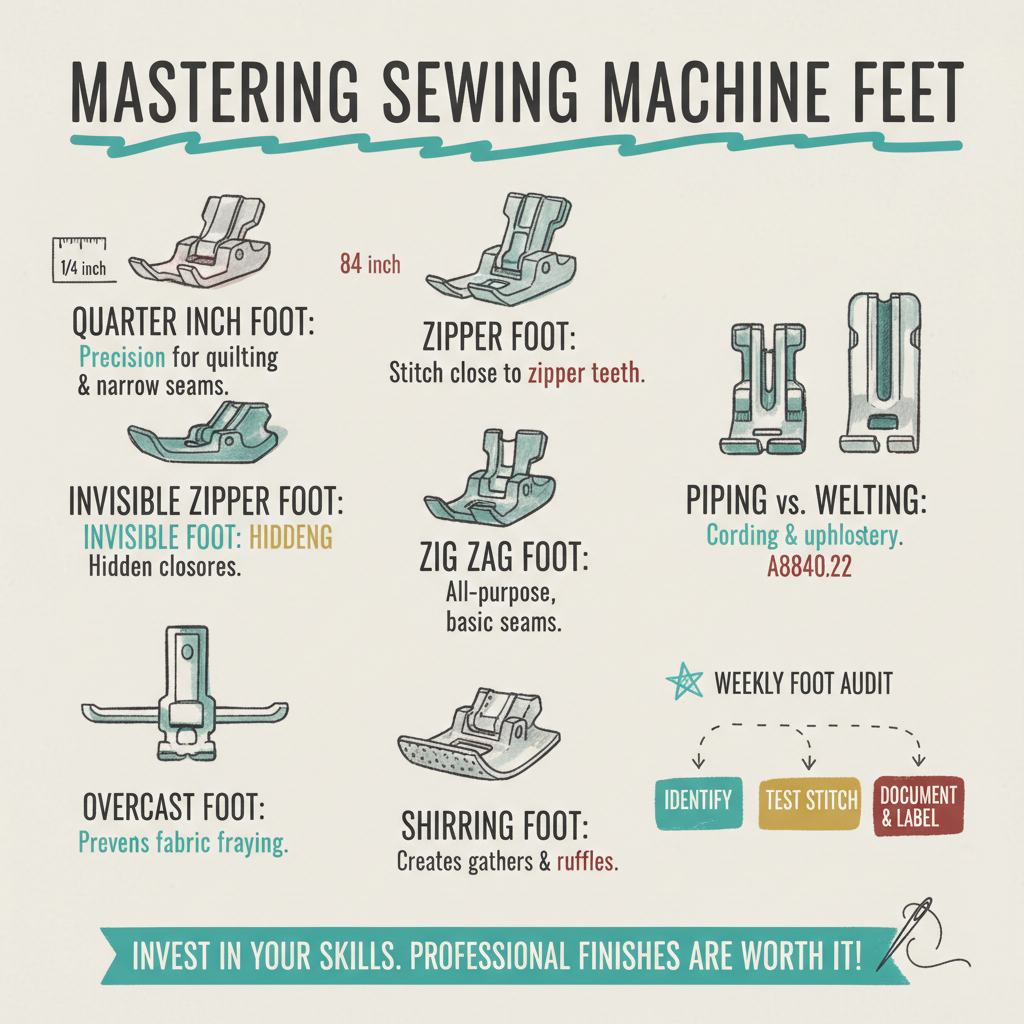
    Often referred interchangeably as a piecing foot, this attachment is the gold standard for quilters. The distance from the needle to the edge of the foot is exactly 1/4 inch. By aligning the raw edge of your fabric with the right-hand edge of the foot, you ensure every seam is uniform. This precision is vital because even a millimetre of error can result in a quilt block that doesn’t lay flat or line up correctly at the corners.

    Improving Your Accuracy

    Many versions of this foot come with a small metal flange or “guide” on the right side. This guide prevents the fabric from drifting, making it an excellent tool for beginners who are still developing their steady hand. Beyond quilting, this foot is incredibly useful for topstitching narrow hems or creating precise seam allowances on delicate doll clothes or intricate garment details.
    Mastering Fasteners and Closures

    Zippers are often the most feared part of a beginner’s journey. However, the right equipment removes the stress entirely.

    What is a Zipper Foot Used For?

    The standard zipper foot is designed with notches on both the left and right sides. This allows the needle to stitch very close to the zipper teeth or “coils” without the foot riding over them. Because the foot is narrow, you can adjust your needle position to get as close as necessary to the edge of the zipper tape. It is a versatile tool that every sewist should master early on.

    What is an Invisible Zipper Foot?

    If you want your fastenings to disappear into the seam of a dress or skirt, you need an invisible zipper foot. Unlike a standard version, this foot features grooves on the underside. These grooves “unroll” the zipper coils as you sew, allowing the needle to stitch right in the “ditch” of the zipper tape. When done correctly, the zipper becomes entirely hidden within the seam line.

    Professional Edges and Finishes

    Not everyone owns an overlocker, but that shouldn’t stop you from achieving a professional finish on your raw edges.

    What is an Overcast Presser Foot Used For?

    An overcast presser foot (sometimes called an overedge foot) is designed to wrap thread around the edge of the fabric to prevent fraying. It features a small bridge or bar in the centre that keeps the fabric flat and prevents the stitches from pulling the edge into a bunch. When used with an overcasting stitch on your domestic machine, it mimics the look of a professional serged edge.

    What is a Zig Zag Foot?

    The zig zag foot is likely the one currently on your machine. It is the “all-purpose” attachment with a wide opening to accommodate the side-to-side movement of the needle. While it is perfect for basic seams, using it for specialized tasks can sometimes lead to fabric tunneling or skipped stitches. It is always better to swap to a dedicated foot when the task becomes more specific.

    Decorative and Structural Specialty Feet

    As you progress to London sewing courses for adults, you will encounter techniques that require even more specialized hardware.

    What is a Piping Foot vs. a Welting Foot?

    The distinction between a piping foot and a welting foot often causes confusion. A piping foot usually has a single groove on the underside to accommodate the corded trim used in garment making. A welting foot, often used in upholstery, usually features two grooves. This allows you to sew closely to the cord and then sew that cord to the main fabric piece in a subsequent pass, ensuring the cord stays perfectly aligned.

    What is a Shirring Foot?

    A shirring foot is a magical tool for creating gathers. It is designed with a specific sole that puts uneven pressure on the fabric, causing it to gather as you sew. You can even tuck a piece of fabric into the slot of the foot to gather the bottom layer while keeping the top layer flat—perfect for attaching ruffles to a skirt in a single step.

    Our Unique Insight: The Psychology of the “Right Tool”

    At our studio, we often notice that a student’s frustration rarely stems from a lack of talent; it usually comes from using the wrong attachment. We believe that learning how to sew is as much about mechanical literacy as it is about creative vision. When you understand the physics of how a foot holds fabric against the feed dogs, you stop fighting your machine and start collaborating with it. Using a specialized foot isn’t “cheating”—it is the mark of a professional who values their time and the quality of their craft.

    Actionable Strategy: Your Weekly Foot Audit

    To truly learn to use a sewing machine, you must get comfortable with its anatomy. Try this strategy this week:

    1. Identify Three Feet: Take three mystery feet from your accessory box that you have never used.
    2. Test Stitch: Use scrap fabric of different weights (cotton, denim, and silk) and try each foot.
    3. Document the Results: Note down which stitch settings worked best. For example, did the overedge foot work better with a wider or narrower stitch?
    4. Label Your Box: Use a small piece of masking tape to label the compartments in your accessory tray so you never have to guess again.

    Is Specialty Sewing Worth the Effort?

    When students ask if investing in extra feet is worth it, the answer is a resounding yes. The difference between a “homemade” garment and a “handmade” one often lies in the details—the perfectly straight topstitching from a quarter inch foot or the crisp edges provided by an overcast presser foot.

    The Value of Professional Instruction

    While YouTube is a great resource, nothing beats the immediate feedback of private sewing lessons London. A tutor can show you exactly how to position your hands and how to adjust the tension for a shirring foot in real-time. This hands-on guidance saves hours of unpicking and ensures your sewing blog worthy projects are successful on the first try.

    Investing in Your Skills

    Enrolling in sewing classes London for adults provides access to high-end machines and a library of specialty feet you might not want to purchase yet. It is a fantastic way to “try before you buy” while building a community of like-minded makers. Whether you are looking for sewing classes London for beginners or more advanced seamstress courses, the focus remains on building confidence through technical proficiency.

    Frequently Asked Questions (FAQ)

    What is a wing needle for sewing machines?

    A wing needle is a unique needle with wide, flat “wings” on the sides of the shank. As it enters the fabric, the wings push the threads aside to create a permanent hole. It is used for decorative heirloom sewing, such as entredeux or hemstitching. It works best on natural, crisp fabrics like linen or cotton batiste, where the weave can be easily manipulated.

    Can I use a zipper foot for piping?

    Yes, you can use a standard zipper foot for piping if you do not have a dedicated piping foot. By moving your needle to the far left or right, you can get quite close to the cord. However, a dedicated piping foot is better because the groove on the underside “locks” onto the cord, preventing it from slipping and ensuring a much more consistent result.

    How do I know if a foot fits my machine?

    Sewing machines generally fall into two categories: low shank and high shank. Most domestic machines are low shank. To check, lower your presser foot and measure from the centre of the screw hole to the needle plate. If it is about 1/2 inch, it is low shank; if it is 1 inch or more, it is high shank. Always check your manual before purchasing.

    Do I really need an overedge foot?

    While a standard zig zag foot can finish edges, an overedge foot provides much more control. The little pin in the middle of the foot prevents the fabric edge from curling or “tunneling” under the tension of the zig-zag stitch. If you want your garments to look professional and last through many washes, it is a very worthwhile, inexpensive investment.

    Conclusion

    The journey from a beginner to an expert maker is paved with small, technical milestones. Understanding what is a quarter inch sewing machine foot and how it differs from a piecing foot or an overedge foot is one of those crucial steps. These attachments are designed to take the guesswork out of your projects, allowing your creativity to flourish without the hindrance of technical errors.

    Whether you are joining us for intermediate London sewing courses or just starting your first project at home, remember that your machine is a powerful ally. By choosing the right foot for the job, you ensure that every stitch is a step toward a garment you can be proud of. From the tiny details of a wing needle to the structural necessity of a zipper foot, these tools are the keys to unlocking your full potential as a sewist.

    About the Author: Grace, Founder of London Sewing Courses

    Grace is the heart and hands behind London Sewing Courses. A passionate and experienced sewing instructor, she founded the studio with a unique mission: to create a calm, friendly space for adults to learn and connect, while using the profits to fund free sewing classes for local children in need. Her personal expertise and commitment to community building are at the core of every class and every stitch.

    Sources

  • Finding Your Perfect Match: What is a Good Serger for Beginners?

    Finding Your Perfect Match: What is a Good Serger for Beginners?

    Key Takeaways

    • No Stress on Skill Level: You don’t need a professional background to master an overlocker (serger). Modern machines are much easier to thread and use than older models.
    • Essential Features: The best beginner sergers feature colour-coded threading, differential feed, and adjustable stitch length/width. These simplify operation and prevent fabric distortion.
    • Top Beginner Brands: Juki and Brother are consistently recommended for their durability, value, and ease of use right out of the box, with Juki often providing a more ‘workhorse’ feel.
    • Differential Feed is Key: This feature is critical for professional-looking seams, preventing both stretching (on knits) and puckering (on fine fabrics).
    • Confidence is Built: Learning to use this machine effectively, perhaps through some dedicated seamstress courses, will completely transform the professional finish of your handmade garments.
    Doodle-style infographic summarizing key takeaways on what is a good serger for beginners, listing essential features, ease of use, and top brands like Juki and Brother.

    The jump from a traditional sewing machine to a serger (also known as an overlocker in the UK) can feel like a big one, even for experienced sewists. Suddenly, there are four threads, looping mechanisms, and a sharp blade, making the process look daunting. If you’ve been asking yourself, “What is a good serger for beginners?”, rest assured, you’re not alone.

    A serger is a specialist machine that simultaneously sews a seam, trims the excess fabric, and encases the raw edge with a strong, looped stitch. This is what gives high-street clothing that professional, clean finish that a standard sewing machine simply cannot replicate. This guide is designed to be your patient, skilled tutor, helping you understand the essential features, navigate the brand landscape, and confidently select the perfect entry-level model to elevate your sewing projects.

    Hand-drawn infographic visualizing essential serger features for beginners, including colour-coded threading paths, differential feed mechanics, and machine versatility options.

    Understanding the Serger: Essential Features

    Before we dive into specific models, you must understand the key features that separate a great beginner machine from one that will cause frustration. An overlocker’s value isn’t measured by the number of stitches it can perform, but by the quality and ease of its core functions.

    🧵 The Threading Revolution: Colour-Coding

    The biggest fear associated with a serger is threading. Older models required intricate manual manipulation, but modern entry-level machines have solved this.

    • Colour-Coded Path: Every good beginner serger will have the entire threading path for all four threads clearly marked with different colours (usually red, blue, green, and yellow).
    • Open Access: Look for a machine that allows the front cover to open wide, giving you unobstructed access to the lower looper, which is often the trickiest part.

    If a machine boasts “air-threading” or “self-threading,” it’s a huge bonus, though this feature often comes with a higher price tag.

    ⚙️ The Magic of Differential Feed

    This is perhaps the single most important feature to look for when considering what is a good serger. Differential feed refers to the machine’s ability to move the fabric with two sets of feed dogs—one in front of the needle and one behind it—moving at different rates.

    • Preventing Puckering: By setting the differential feed higher than 1.0 (e.g., 1.3 or 1.5), you can stretch the fabric slightly as it passes through, preventing wavy seams on stretchy knit fabrics.
    • Creating Gathers: Conversely, setting the differential feed lower than 1.0 (e.g., 0.7) can intentionally create a beautifully gathered effect on woven fabrics.

    A machine without this feature will make sewing knits, jersey, and fine fabrics incredibly frustrating, leading to stretched, unprofessional results.

    📏 Versatility and Control

    Your machine needs to be adaptable to different fabric types and project requirements.

    • Adjustable Stitch Length and Width: You should be able to easily adjust the length and width of the overlock stitch. A wider stitch (around 7mm) is ideal for heavy fabrics, while a narrower, shorter stitch is better for garment hems and fine materials.
    • The Knife Bypass: A crucial component that allows you to disengage or swing the cutting blade out of the way. This is essential when you want to use the overlock stitch purely for finishing a pre-cut edge without trimming any material.
    • Free Arm Capability: While less common on budget models, a free arm allows you to easily sew small, circular items like cuffs, sleeves, and necklines, significantly increasing the machine’s utility for garment making.

    Brand Wars: Finding the Best Entry-Level Machine

    When you ask seasoned sewists what is a good serger, a few brand names dominate the conversation. We’ll look at four major players, assessing them for a beginner’s needs, value, and overall performance.

    Juki: The Industrial Workhorse

    Juki was originally known for its industrial machinery, a reliability that translates beautifully into their domestic line. For many, Juki sergers are often regarded as the best value for money for a dedicated, high-quality machine. They are built to stand the test of time.

    • Top Pick: The Juki MO-654DE is universally recommended as an excellent entry-level serger. It offers the essential features—colour-coded threading, adjustable stitch length and width, and differential feed—in a reliable, easy-to-use package.
    • Pros: Exceptional stitch quality, highly durable, excellent tension control.
    • Cons: Can be louder and heavier than other brands. Threading the lower looper can still be a bit fiddly initially compared to air-threading models.

    Brother: The Beginner’s Best Friend

    Brother machines often shine in the entry-level market due to their emphasis on ease of use and affordability.

    • Top Pick: The Brother 1034D (or similar, widely available models) is a frequent suggestion for new serger users. It’s often highly recommended for its ease of use right out of the box.
    • Pros: Generally the most affordable option, very clear and simple threading guides, excellent included accessories.
    • Cons: Not as durable or robust as Juki for high-volume use; the quality of internal components can feel lighter. They can be a great starting point, but many serious sewists upgrade after a few years.

    Baby Lock: The Luxury Option

    If you’re wondering what is a babylock machine, you’re looking at the top end of the market. Baby Lock is renowned for its patented Jet-Air Threading system, which eliminates all threading fuss by using a puff of air.

    • Pros: Effortless, immediate threading—a huge time saver. Exceptional stitch quality and reliability.
    • Cons: Significantly more expensive than Juki or Brother models, often pricing them out of the entry-level budget. A beginner doesn’t necessarily need this luxury, but it certainly speeds up the learning curve.

    Singer and Pfaff: The Traditionalists

    While names like what is a good singer sewing machine or what is a pfaff sewing machine are synonymous with standard sewing, their sergers can be a mixed bag.

    • Singer: Their budget sergers are affordable but often lack the build quality and smooth operation of Juki or Brother. They are an option if budget is the absolute priority, but they may lead to more frustration.
    • Pfaff: Known for precision and high-quality construction, but their sergers tend to be pricier than their equivalents, pushing them towards the intermediate or advanced user.

    Actionable Strategy: The ‘Serger Starter Kit’

    If you’ve identified what is a good serger for beginners and are ready to take the plunge, follow these three simple steps to ensure a smooth transition and rapid skill development. These small, non-numerous suggestions will significantly reduce the learning curve.

    1. Buy Two Extra Cones of Thread (Total Six)

    While a serger uses four threads, you should buy six cones: two in black, two in white, and two in a bright, contrasting colour (e.g., neon yellow or orange).

    • The Rationale: Load the two loopers with the bright, contrasting thread. This allows you to easily see how the threads are interlocking when you test your tension, making it simple to diagnose any issues. Once the tension is perfect, switch to the matching black or white thread for your projects.

    2. Dedicate a Time Slot for Tension-Only Practice

    Don’t attempt to start a project immediately. Spend your first two hours doing nothing but setting up the machine and testing the tension dials.

    • The Method: Take a few fabric scraps—a knit, a denim, and a cotton—and label them. Thread the machine and stitch. Adjust the tension dial for one thread by a full number, stitch again, and write down the setting on the fabric scrap. Continue this process until you understand how each dial (Needle Left, Needle Right, Upper Looper, Lower Looper) affects the stitch. This foundational knowledge will save you hours of guesswork later.

    3. Seek Local, Hands-On Guidance

    While instruction manuals are helpful, a serger is best learned in person. Look into local workshops or private sewing lessons London.

    • The Benefit: A tutor can show you how to thread your specific machine in minutes, a task that might take an hour of struggle with a manual. They can instantly diagnose tension issues and demonstrate the correct knife pressure for various fabrics, which is invaluable. Search for sewing classes north london or sewing classes london for adults that specifically offer overlocker introduction workshops.

    Our Unique Insight: Serger vs. Sewing Machine

    For many years, the debate has been, “what is a better sewing machine brother or singer?” in the context of a standard lockstitch machine. However, the true comparison for professional garment construction is between a regular machine and an overlocker. They are not competitors; they are partners.

    A serger’s speed and ability to finish seams rapidly are unmatched. It also excels at creating flatlock, rolled hems, and beautifully stretchy seams on knit fabrics. But it cannot sew darts, topstitch, insert zips, or perform buttonholes.

    For a new sewist, the best setup is a reliable standard sewing machine (like a high-quality Brother or Juki home model) paired with an excellent entry-level serger. The combination allows you to handle every step of garment construction with professional finesse. Understanding this partnership is the key to moving beyond simply making clothes to crafting high-quality garments.

    Frequently Asked Questions (FAQ)

    What is a good inexpensive sewing machine to buy for a beginner?

    While this article focuses on sergers, if you are looking for a standard machine, consider the Brother CS6000i or the Janome 2212. These machines offer a great balance of features (multiple stitches, easy operation) with a highly approachable price point. They are durable workhorses perfect for learning the fundamental skills like straight seams and zig-zags before you progress to more complex seamstress courses or projects.

    Should I choose a Juki or a Baby Lock serger for the long term?

    For long-term reliability and professional-grade performance, the Juki is often the better choice, providing an excellent workhorse at a mid-range price. However, if your budget allows for a Baby Lock, the air-threading system significantly improves the user experience. Both are durable, but the Baby Lock provides a major quality-of-life upgrade, while the Juki offers a more traditional and highly robust experience that will last for decades if well-maintained.

    What is a good inexpensive sewing machine brand for general use?

    In the UK market, Brother and Janome consistently offer the best value for money in the general-use category. They have a wide selection of models at affordable prices that feature modern comforts like top-loading bobbins and simple controls. Avoid unbranded or very cheap machines as they often lead to frustration. If you are aiming for high-end tailoring, the precision of a Bernina or Pfaff is worth the investment later in your sewing journey.

    What is a better sewing machine: Brother or Singer?

    Historically, Singer was the gold standard, but in the modern, budget-friendly market, Brother often outperforms Singer in terms of build quality, ease of use, and overall value in their entry-level models. Brother machines often have a smoother operation and better included features for a similar price. Juki and Janome are also strong contenders for quality and value, often being the choice of those who take garment construction seriously and are learning how to sew.

    Is it necessary to take beginner sewing classes before buying a serger?

    While it is possible to jump straight into a serger, it’s highly recommended that you first learn the basics of a standard machine, perhaps through sewing classes London for adults. This will give you confidence in handling fabric, managing tension, and understanding stitch functions. Once you’re comfortable with basic garment construction, then the serger will feel like a tool to enhance your existing skills, rather than an entirely new, overwhelming process.


    Conclusion

    The journey to finding what is a good serger for beginners doesn’t have to be complicated. The ideal machine is one with colour-coded threading, differential feed, and a reputation for reliable tension (like the Juki MO-654DE). Don’t let the multi-thread setup intimidate you. With a little dedicated practice and perhaps a short, focused course, you’ll soon be achieving the kind of professional, high-street finish that will make your handmade garments truly indistinguishable from shop-bought quality. It’s an investment that pays dividends in both the quality of your craft and your confidence.

    Ready to gain the confidence and skill you need to master your new machine? Explore our Intermediate London Sewing Courses for Adults and dedicated workshops to unlock the full potential of your serger.

    About the Author: Grace, Founder of London Sewing Courses

    Grace is the heart and hands behind London Sewing Courses. A passionate and experienced sewing instructor, she founded the studio with a unique mission: to create a calm, friendly space for adults to learn and connect, while using the profits to fund free sewing classes for local children in need. Her personal expertise and commitment to community building are at the core of every class and every stitch.

    Sources

    The Best Sergers and Overlockers (https://blog.closetcorepatterns.com/the-best-sergers-and-overlockers/)

    Juki MO-654DE vs. Baby Lock Vibrant BL-460B: Choosing My First Serger

    (https://www.deborahjsews.com/juki-mo-654de-vs-baby-lock-vibrant-bl-460b-choosing-my-first-serger/)

    Choosing a New Serger

    (https://clothhabit.com/choosing-a-new-serger/)